What is automated proofreading in regulated industries?
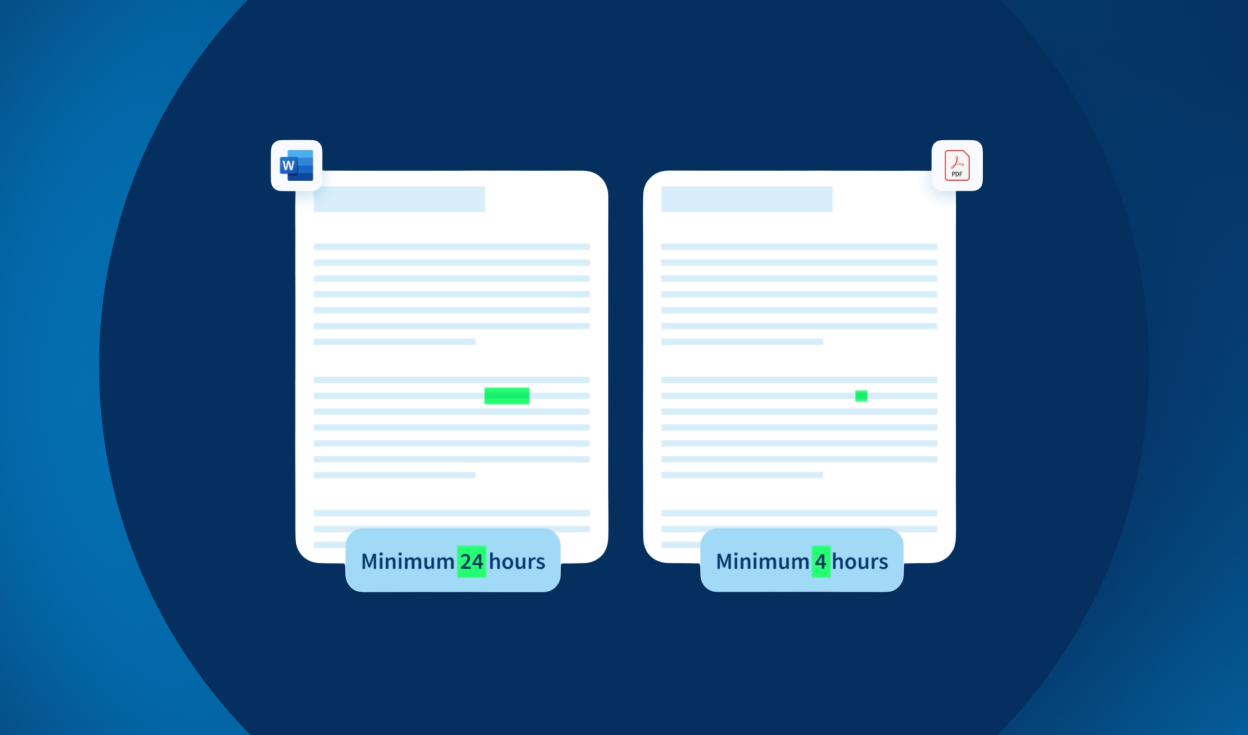


Table of contents

Manual vs Hybrid vs Automated: A Complete Guide
Why manual proofreading is no longer enough
You’ve checked the document carefully. You’ve read every line. And yet, somewhere in a 47-page multilingual package insert, a decimal point is in the wrong place. A symbol is missing. An unapproved phrase made it through.
It’s not a failure of diligence. It’s a failure of the process. Manual proofreading — however carefully carried out — was never designed to reliably catch every deviation in dense, complex, regulated content. The human brain fatigues. Familiarity breeds inattention. And in pharmaceutical labelling, medical device documentation, or clinical trial materials, the consequences of a missed error are not abstract: they are recalls, regulatory action, and risks to patient safety.
The reviewers doing this work are skilled, experienced professionals — and they deserve a process that matches their expertise. One that handles the mechanical work of comparison, so they can focus on the judgements only they can make.
This is why automated proofreading is becoming essential in regulated workflows — not to replace reviewers, but to give them the foundation they need to work accurately, efficiently, and with confidence.
What is automated proofreading?
Automated proofreading is a software-driven process that compares approved source content against a final output document, systematically detecting any deviations between the two.
Unlike manual review, which depends on human attention and judgment, automated proofreading works at the character and Unicode level — catching errors that trained proofreaders routinely miss due to fatigue, familiarity, or cognitive overload.
What automated proofreading software verifies:
- Text — words, numbers, units of measurement, and punctuation
- Formatting — font, size, bold/italic styling, and paragraph layout
- Structure — tables, positioning, and content relationships
- Graphics — logos, symbols, and artwork elements
- Barcodes — multiple barcode types, with grading
- Multilingual content — including non-Latin scripts such as Arabic, Hebrew, and Korean, and right-to-left reading directions
Automated proofreading works across document formats — Word, PDF, XML, and print-ready artwork files — and supports full audit trail documentation, making it suitable for validated, compliance-driven environments.
Manual vs hybrid vs automated proofreading: what’s the difference?
Not all proofreading approaches are equal. Understanding the three main models helps organizations choose the right strategy for their workflow and risk profile.
Manual Proofreading
Manual proofreading is a human-only review process. Common methods include reading content aloud between two people, or performing side-by-side visual comparisons of two document versions.
While manual review has been the industry standard for decades, it carries significant limitations in regulated environments:
- Fatigue — concentration degrades over long review sessions
- Inconsistency — error detection rates vary between reviewers and across time
- Speed — manual review is slow, particularly for complex or multilingual documents
- Cost — two-person read-aloud sessions tie up highly qualified staff for extended periods
Hybrid Proofreading
Hybrid proofreading combines human review with basic digital tools — most commonly Microsoft Word’s track changes feature or Adobe Acrobat’s document comparison function.
This is the most common approach in use today. While it improves on purely manual review, hybrid methods carry their own limitations:
- Generic tools are not built for regulated workflows or compliance documentation
- Formatting deviations and layout changes are frequently missed
- Multilingual content and structured relationships between content elements are poorly handled
- Audit trails are incomplete or non-existent
Automated Proofreading
Automated proofreading software performs the comparison; humans validate the results. This is a critical distinction.
With automated proofreading, reviewers shift from finding errors to reviewing flagged deviations — a fundamentally different cognitive task that is faster, less fatiguing, and more reliable.
Automated tools purpose-built for regulated industries detect deviations across all content types, support multilingual and multi-format workflows, and generate the documentation required for regulatory audit and validation.
At a Glance: Comparing the Three Approaches
| Approach | Speed | Accuracy | Compliance | Scalability |
|---|---|---|---|---|
| Manual | Low | Medium | Low | Low |
| Hybrid | Medium | Medium | Medium | Medium |
| Automated | High | High | High | High |
TVT vs Generic tools
Basic proofreading tools are built for writers. Regulated industries need something different — a verification layer that catches every deviation across complex formats, languages, and workflows without creating new risks.
Why manual proofreading is not enough in regulated industries
Human performance is not a constant. Even the most experienced, diligent proofreader cannot sustain peak accuracy across an eight-hour day of repetitive document comparison and in regulated industries, consistency is not optional.
The human limitations
- Fatigue — attention and accuracy decline significantly after sustained periods of review
- Repetition — familiarity with content increases the likelihood of overlooking errors
- Cognitive overload — complex documents with multiple languages, formats, and layouts exceed human processing capacity
The real-world risks
The consequences of a missed error in pharmaceutical or medical device labelling are severe:
- Incorrect dosage information that reaches patients
- Missing or incorrect safety symbols
- Unapproved text included in a final artwork file
- Instructions for use that deviate from the approved master document
The business impact
- Product recalls — costly, operationally disruptive, and potentially damaging to patient outcomes
- Regulatory penalties — including warning letters, import alerts, and fines
- Litigation exposure — arising from errors that cause harm or include misleading information
- Reputational damage — to brands that depend on patient and prescriber trust
- Employee wellbeing — the chronic stress of high-stakes manual review takes a measurable toll
Where automated proofreading fits in labeling and artwork workflows
Automated proofreading does not replace the overall artwork or labeling workflow — it fits within it, at the most critical quality gate before production.
A typical regulated labeling workflow moves through the following stages:
- Source content creation — SmPC, IFU, regulatory text
- Artwork and layout — design agency or in-house
- Review and comparison stage — this is where automated proofreading operates
- Final approval and sign-off
- Production and distribution
The review stage is the last quality assurance gate before content reaches production. Errors that pass this stage enter the supply chain. Automated proofreading makes this gate reliable, repeatable, and documentable.
Benefits of automated proofreading for compliance
- Faster review cycles — automated comparison takes a fraction of the time required for manual review
- Higher accuracy — character-level and Unicode-level detection catches errors invisible to the human eye
- Reduced recall risk — deviations are caught before content enters production
- Better use of expert time — reviewers focus on validation and decision-making, not mechanical comparison
- Audit-ready documentation — every review step is logged, timestamped, and traceable
- Reduced cognitive load and stress — reviewers work from a structured list of flagged deviations rather than searching for errors in dense content
The human benefit is often underestimated. Automated proofreading does not make reviewers redundant — it makes their work more meaningful, less exhausting, and more defensible.
How automated proofreading supports compliance
In regulated industries, the proofreading process itself must be compliant — not just the output. Automated proofreading software designed for pharmaceutical and medical device environments supports:
- 21 CFR Part 11 (FDA) — electronic records and electronic signatures requirements
- EU Annex 11 — computerized systems validation in pharmaceutical manufacturing
- Audit trails — complete, tamper-evident records of every review action
- Traceability — linking each review to the source document, reviewer, and timestamp
- Validation documentation — supporting IQ/OQ/PQ requirements for computerized systems
Compliance is not only about the content of documents — it is also about the integrity of the process used to review them. Automated proofreading provides both.
How automated proofreading works
The process is straightforward, even for complex multilingual or multi-format documents:
- Upload the source document (approved master) and the target document (final version or artwork)
- The software compares both documents at the Unicode level — inspecting the unique computer code for each character, symbol, and element
- Deviations between the two documents are automatically flagged and presented to the reviewer
- The human reviewer examines each flagged deviation and makes a determination
- All steps are logged in a timestamped audit trail
This workflow supports documents in virtually any language — including non-Latin scripts such as Arabic, Hebrew, and Korean — and any format, from Word and XML to print-ready PDF artwork.
Manual vs automated: a real-world example
Before automation
A pharmaceutical company reviewing artwork for a multilingual package insert assigns two trained reviewers to read the content aloud to each other — one following the approved master, the other checking the final artwork. The process takes eight hours. It must be repeated for each language version. Error rates remain above zero.
After automation
The same review is completed in under two hours. The software compares all language versions simultaneously, flags every deviation, and generates a complete audit trail. The two reviewers spend their time validating flagged deviations rather than manually scanning hundreds of lines of text.
Same review. Same team. A fraction of the time — with higher accuracy and a complete compliance record.
Why specialised tools are used in regulated industries
Generic document comparison tools — word processors, PDF viewers, standard spell checkers — were not designed for regulated workflows. They lack:
- Support for validated environments (21 CFR Part 11, Annex 11)
- Multilingual and multi-script comparison capability
- Multi-format comparison across Word, PDF, and artwork files
- Audit trail generation meeting regulatory requirements
- Integration with labelling and content management systems
Purpose-built tools like TVT are designed specifically for the accuracy, traceability, and workflow integration requirements of pharmaceutical and medical device labelling. TVT supports text, artwork, barcode, and spelling verification within a single validated platform — and integrates with existing information systems.

The buyer’s guide to content verification software for regulated industries
Learn how to evaluate automated proofreading tools for compliance, accuracy, and workflow fit.
Get the buyer guideWhat is automated proofreading?

Automated proofreading is software-driven document comparison that detects deviations between an approved source document and a final output — across text, formatting, graphics, barcodes, and multilingual content.
How is automated proofreading different from manual proofreading?
Manual proofreading relies entirely on human attention to find errors. Automated proofreading uses software to detect all deviations, with humans reviewing and validating the flagged results. The human role shifts from searching for errors to making decisions about identified deviations.
Is automated proofreading compliant with FDA and EMA requirements?
Purpose-built automated proofreading tools designed for regulated industries support 21 CFR Part 11 (FDA) and EU Annex 11 (EMA) requirements, including electronic audit trails, validation documentation, and traceability. Generic tools do not.
Can automated proofreading replace human reviewers?
No. Automated proofreading replaces the mechanical task of searching for errors — it does not replace human judgment. Reviewers remain essential for evaluating whether flagged deviations are acceptable, require correction, or require escalation.
Which industries use automated proofreading?
Automated proofreading is most widely adopted in pharmaceutical and biotechnology companies, medical device manufacturers, contract development and manufacturing organisations (CDMOs), and regulatory affairs teams managing multilingual labelling across multiple markets.