What tools verify regulatory-compliant artwork and label content?


Table of contents
- What counts as "regulatory-compliant" artwork and label content?
- What tools help ensure regulatory-compliant artwork for medical device packaging?
- What tools verify dosage, contraindications, and warnings on medicine labels?
- How automated verification differs from manual proofreading and from AI drafting tools
- A quick checklist: what to look for in an artwork or label verification tool

A mislabeled decimal. A missing contraindication. A symbol that’s one revision out of date. Each is a different kind of slip, but they all trace back to the same gap: a review process that relies on a person reading carefully enough to catch something that isn’t supposed to be there anymore.
If you’re a regulatory or artwork lead in medical device, you’re likely trying to catch deviations across packaging, symbols, and barcodes before they reach print. If you’re in pharma QA, you’re more likely watching for dosage, contraindication, and warning language that has to match the last approved version exactly, in every language you ship. Different documents, same underlying problem, and increasingly, the same category of tool solving it.
This piece breaks down what “regulatory-compliant” actually covers, which tools exist to verify it, and what to look for in one, regardless of which side of that split you’re on.
Key takeaways
- Regulatory-compliant artwork and label content covers two distinct layers: graphics and symbols on one side, text content like dosage and warnings on the other. Most teams need coverage for both.
- Automated proofreading and comparison software, artwork management (PLM) systems, and barcode/symbol verification tools are the three tool categories doing this work today.
- Automated verification is a different category from both manual proofreading and generative AI drafting — it’s a deterministic compare-and-catch step, not a replacement for human sign-off.
- A validatable audit trail, multilingual comparison, and broad file-format support (Word, PDF, XML, HTML, image, barcode) are the non-negotiables when evaluating a tool.
What counts as "regulatory-compliant" artwork and label content?
Split it into two layers. Artwork is the graphics side: logos, symbols, barcodes, layout, color, and the physical structure of packaging. Label or package-insert content is the text side: dosage, warnings, contraindications, ingredients, and instructions for use. A carton can be visually flawless and still be non-compliant if the warning text underneath is outdated — and it can have perfect text and still fail if a printer’s proof buries a critical symbol under an overprint layer.
The frameworks that define “compliant” depend on where you’re shipping. In the US, pharma labeling sits under 21 CFR Part 201, with electronic records and signatures governed separately by 21 CFR Part 11. Medical device packaging adds MDR and ISO 15223-1 symbol requirements on top. In the EU, EMA’s QRD templates set the pattern for pack leaflets. We go deeper on the regulatory side in a companion piece on FDA, EMA, and 21 CFR Part 11 compliance — this piece stays focused on the tools.
One distinction worth making early: “compliant” isn’t the same as “accurate.” A label can be accurate today and still fail an audit six months from now if there’s no record of who approved it, when, or against what. Compliant means accurate and provable.
What tools help ensure regulatory-compliant artwork for medical device packaging?
Three categories of tool do most of the work here, usually together rather than as a single piece of software:
- Artwork management (PLM) systems hold the approved source content and manage version history across departments — regulatory, design, and marketing all touching the same file at different stages.
- Automated proofreading and comparison software checks a new artwork file against the last approved version, flagging deviations a visual read wouldn’t catch.
- Barcode and symbol verification tools confirm that UDI codes, 2D matrix codes, and ISO 15223-1 symbols are present, correctly placed, and actually scannable.
When you’re evaluating tools in this category, look for side-by-side version comparison (not just a visual overlay), a current ISO 15223-1 symbol library, UDI and barcode read-and-verify, multilingual consistency checks across every market you ship to, and full version history tied to a name and a timestamp.
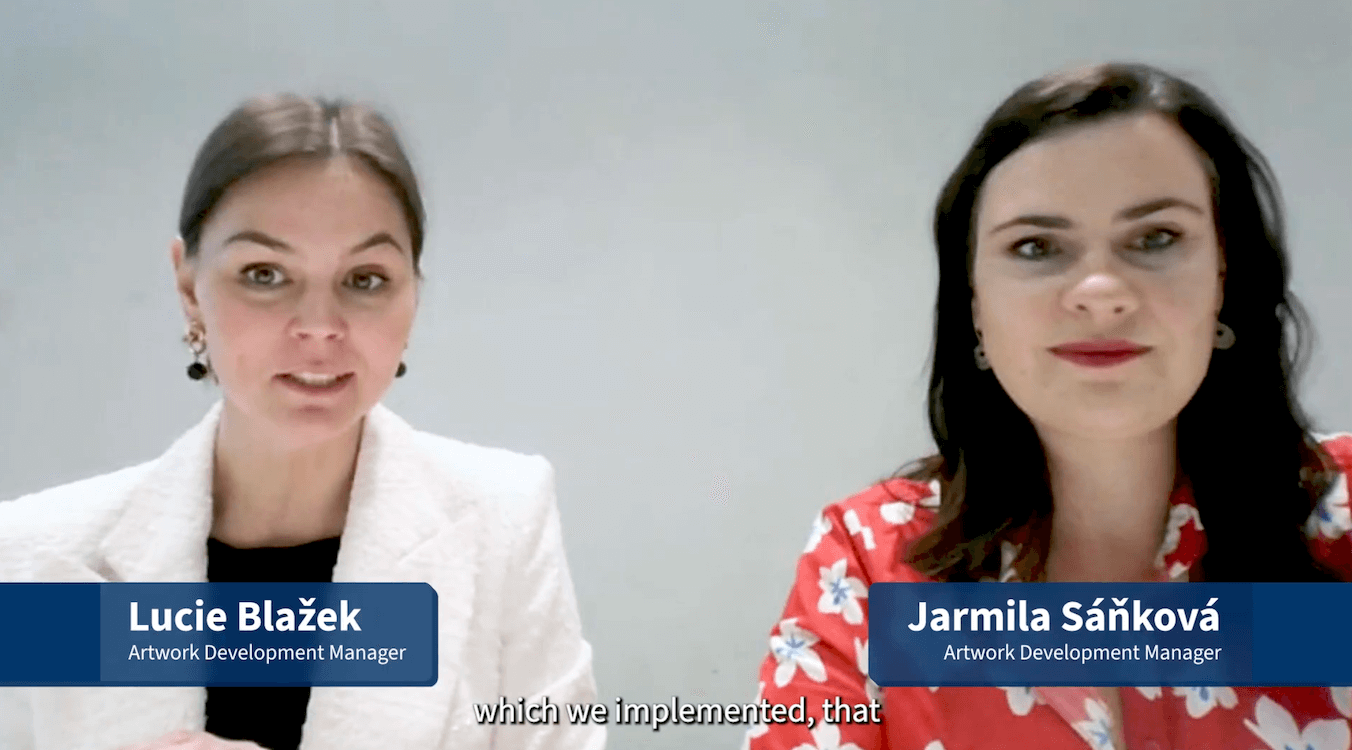
This is the layer TVT Artwork is built for — comparing complex artwork files pixel by pixel to catch deviations like overprint layer placement or color shifts that a visual check misses, and TVT Barcode handles the scannability check on top of that. Dr. Max Pharma’s artwork development team, for example, uses TVT Artwork to independently handle reviews across more than 1,200 products spanning food supplements, OTC products, medical devices, and consumer goods, without adding headcount to the regulatory affairs team. For the regulatory backdrop specific to device packaging, see our breakdown of medical device labeling requirements under FDA, MDR, and UDI, and for the process this fits into, navigating medical device regulations for labeling artwork and from review to approval: the medical device labeling workflow.
Handling packaging and labeling reviews across 1,200+ products
See how Dr. Max Pharma’s artwork team went from hours to minutes on packaging reviews across 1,200+ SKUs, and cut Regulatory Affairs out of a step they no longer needed.
What tools verify dosage, contraindications, and warnings on medicine labels?
On the pharma side, the risk sits mostly in text: a decimal point in the wrong place, a contraindication that didn’t carry over to a new market’s leaflet, a warning that’s worded differently on the carton than on the insert. The tools built for this are:
- Automated text-comparison software that checks every version of a label against the last approved one, regardless of language or file format.
- Structured content platforms — built around standards like Structured Product Labeling (SPL) or IDMP — that hold the approved source data and let teams cross-reference against it rather than re-typing it into each new document.
The importance of structured content in product labeling comes down to this: when your approved dosage and warning language lives in one governed place, verification tools have a single source of truth to check against instead of trusting that whoever copied it in got it right. If your organization is weighing an IDMP-driven approach, it’s worth reading what actually works and what doesn’t in our look at IDMP in practice before committing to one.
This is where TVT’s core comparison engine does the heaviest lifting: it checks every label, leaflet, and carton against the last approved version, in any language, and flags differences a read-through is likely to miss — a wrong decimal, a dropped contraindication, a warning that reads differently across pack components. See how that plays out end to end in our pharmaceutical labeling workflow, from clinical submission to printed packaging, and how the same check holds up across markets in multilingual labeling best practices.
How automated verification differs from manual proofreading and from AI drafting tools
It’s worth being precise about what this category of software is, because it gets lumped in with two things it isn’t.
It isn’t a replacement for a human proofreader. Regulated labeling still needs a person to review and sign off — automated verification removes the risk of missing something in that review, it doesn’t remove the review itself. And it isn’t a generative AI drafting assistant. AI can genuinely help with drafting and translation, but the compliance-critical step — checking a final version against the last approved one — needs deterministic, validatable accuracy with a human still in the loop, not a model’s best guess.
The gap this closes is bigger than it sounds. At the FDA’s benchmark of 97–98% human proofreading accuracy, a standard 2,600-word patient information leaflet still has roughly 52 words that could be wrong. For labeling, which functions as a safety component, that’s not a rounding error. Our article on why top pharma companies use document comparison software to proofread labeling walks through why manual review alone consistently falls short of that bar, no matter how careful the reviewer.
A quick checklist: what to look for in an artwork or label verification tool
Whichever side of this you’re solving for, the same handful of things separate a tool that holds up under audit from one that doesn’t:
- Validatable accuracy — not just “high accuracy,” but accuracy you can prove and defend if a regulator asks how you know.
- Broad file-format coverage — Word, PDF, XML, HTML, image and artwork files, and barcodes, not just plain text.
- A full audit trail — every flagged deviation tied to a specific change, a specific version, and a specific person.
- Multilingual comparison — checking translated content against the source, not just proofing each language in isolation.
- Fit with existing workflows — a tool that plugs into your artwork management or PLM system, rather than asking your team to work around it.
For a longer list to bring into a vendor evaluation, our 13 questions to ask before choosing a text comparison software covers the ground this checklist only summarizes, and the buyer’s guide to content verification software for regulated industries walks through the same evaluation in more depth if you’re building a business case. And if you want to see how this fits together as one workflow rather than a stack of separate checks, TVT Workflow shows how text, artwork, and barcode verification connect from submission to print.
A few quick answers to round out this piece — which tools handle artwork versus label content, and whether any of this is actually required by regulators.
What tools help ensure regulatory-compliant artwork for medical device packaging?

Automated proofreading and comparison software — like TVT, TVT Artwork and TVT Barcode — along with artwork management (PLM) systems, used together to catch deviations across graphics, symbols, and text that a visual review alone would miss.
What tools help verify dosage, contraindications and warnings on medicine labels?
Automated text-comparison software, such as TVT, that checks every label version against the last approved one in any language — often paired with structured content platforms (SPL/IDMP) that hold the approved source data.
Is automated label verification required by the FDA or EMA?
Neither regulator mandates a specific tool, but both expect labeling processes to be validated, auditable, and consistently accurate. That’s why automated verification with a built-in audit trail — the approach TVT is built around — has become the practical standard in regulated review.
What's the difference between artwork verification and label proofreading?
Artwork verification checks graphics, symbols, barcodes, and layout; label proofreading checks the text content itself — dosage, warnings, ingredients. TVT and its modules (TVT Artwork, TVT Barcode) cover both, rather than requiring separate tools for each.