13 questions to ask when choosing comparison software
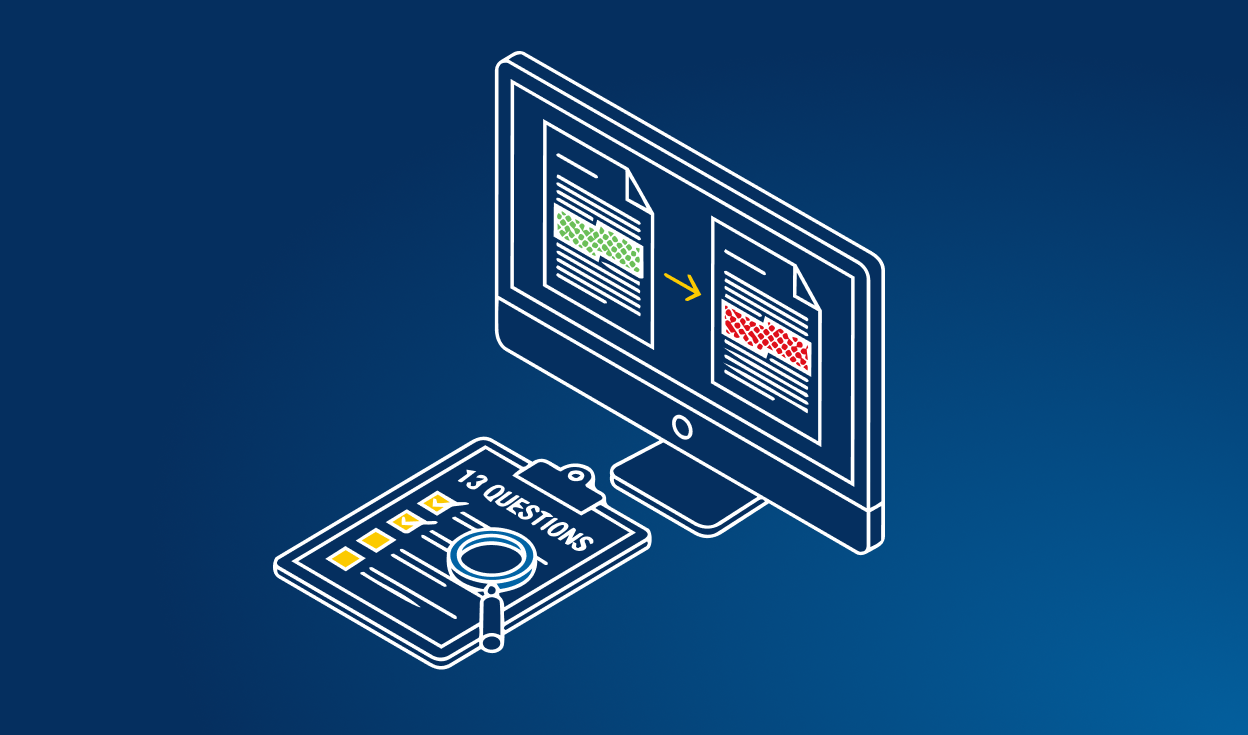




Are you thinking about automating your proofreading with a document comparison software? Then it’s important your choice is an informed one. We’ve put together a set of questions to ask yourself before deciding in favour of a particular solution.
Questions to ask yourself and your team when choosing comparison software:
1. What kind of documents do I need to review, proofread or compare?
Automated proofreading software is based on the principle of document comparison. It compares an original approved document with a copy in order to find deviations or differences. The most future-proof solution is one that can find deviations in both text and graphics in a document (e.g. logos).
2. What file formats do I need to compare?
Your solution should be flexible enough to compare different file formats at the same time. If not, you will be resorting to manual proofreading for non-compatible files. Typical file formats used in life science are Word, PDF, XML, XLS and HTML.
3. Can the solution compare foreign languages, particularly those using non-Latin script?
It is not uncommon for life science companies to sell their products in many different countries, and therefore have to deal with documents in multiple languages. The regulatory affairs department many be centralized in one or two locations, and not have native speakers on the team. Using a proofreading software solution that can not only identify deviations but also comes with the option of identifying typos in multiple languages allows non-native speakers to easily check content and identify potential issues, saving time and translation resources.
4. How many users need access to the solution, and are these users proofreading in the same office or across multiple locations?
It goes without saying that your needs today will not be the same as your needs in the future, as your business continues to grow. The software solution you choose should be easily scalable and easily accessible across many offices as well as remotely.
5. Do I need to verify barcodes?
Barcodes are becoming increasingly unavoidable in life sciences. If healthcare and pharmaceutical industry codes are present on your labeling and packaging, you will need a proofreading software solution that can grade their quality to the GS1 standard.
6. Do we want to manage the system ourselves, and if not, do we have IT resources to allocate?
Good proofreading software is easy to implement and requires few resources, but it’s important to clarify your organizations IT requirements from the outset. Make sure to involve a responsible from your IT department early on.
7. Do I want the solution to integrate with workflow solutions such as Regulatory (RIM), Artwork (AMS), Document or Content Management systems?
Today, workflows are digital, often with different companies and departments working with different programs and systems. We strongly recommend that your solution have the option to be integrated with these programs and systems, making your choice future-proof.