The hidden cost of getting it wrong: what executives in regulated industries need to know about content verification



It takes over a decade and often more than a billion dollars to bring a regulated product to market. And yet, for many companies, the final step before that product reaches patients or consumers is still a person reading a document out loud while a colleague marks it up.
That gap, between the sophistication of the process and the fragility of its final check, is where recalls happen, launches stall, audits get complicated, and digital transformation quietly stalls.
Content verification isn’t a back-office concern. It’s a strategic risk, a revenue lever, and an unfinished chapter in most organizations’ digitization story. Here’s why it belongs on the executive agenda.
The recall risk is larger than most teams acknowledge
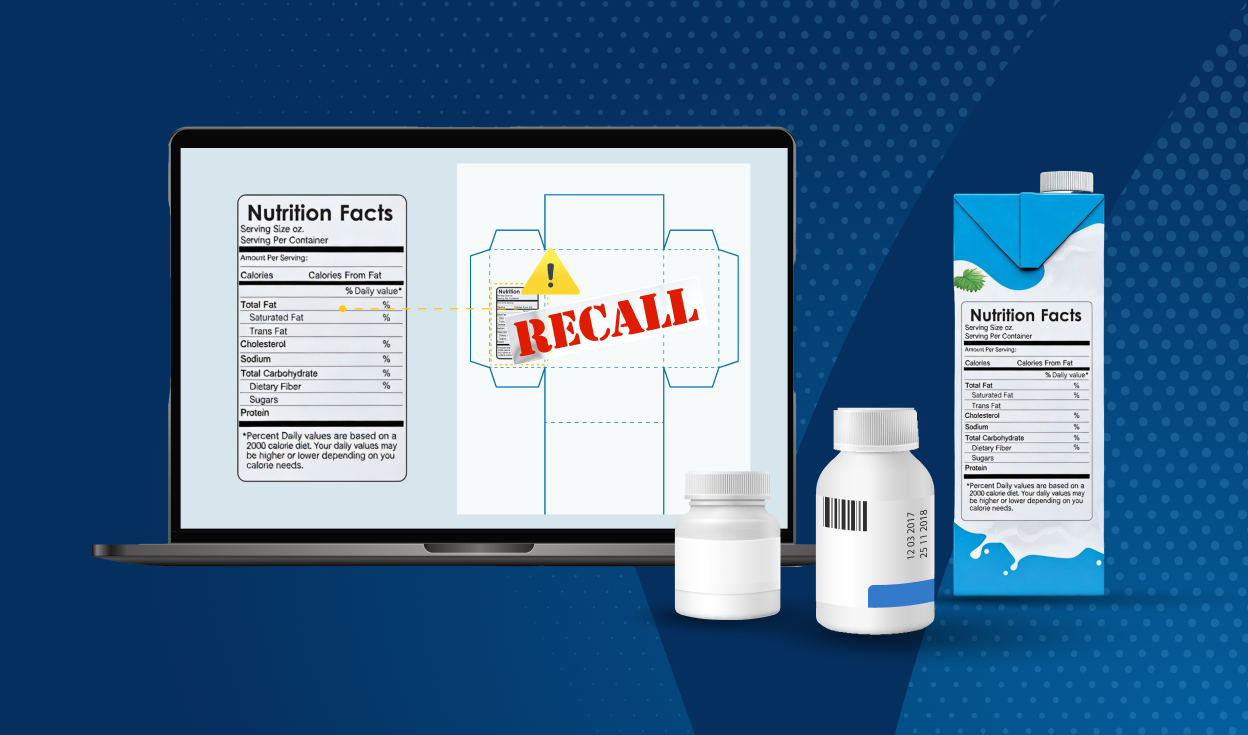
Over 50% of product recalls in life sciences are caused by packaging and labeling errors, not manufacturing failures, not supply chain issues, but content mistakes. And the financial exposure is substantial: a typical recall costs a minimum of US$1 million, with complex cases exceeding US$100 million once you factor in product recovery and destruction, repackaging and relabeling, regulatory remediation and CAPA implementation, litigation, and the long tail of brand damage.
But the more instructive number is the cost of a near-miss caught too late. In one widely cited case, a Swiss manufacturer discovered a labeling misprint just before releasing a cough syrup ahead of winter. The product wasn’t recalled, but the delay pushed the launch past the seasonal window. The resulting loss of market share cost an estimated €517–620 million. Not from a recall. From a late catch.
When a quality failure does occur and corrective and preventive action (CAPA) is required, the costs compound further. If the FDA determines a CAPA is inadequate, the consequences escalate: warning letters, intensified scrutiny, and downstream costs that can dwarf the original incident.
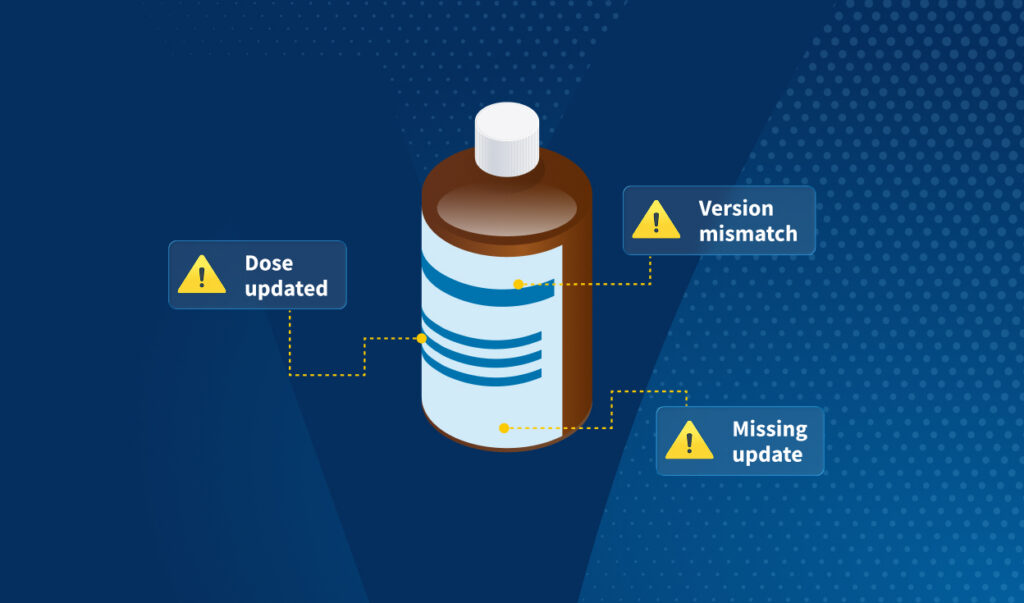
The pattern is consistent: errors that survive content review create cascades. Each stage that passes without detection adds cost, delay, and regulatory exposure to what started as a fixable mistake.
Review cycles are quietly eroding your launch timelines
Most leadership teams are aware that labeling delays happen. Fewer have a clear picture of how much those delays are costing, or how structurally they’re built into the current process.
Manual proofreading, as a primary verification method, averages 3–4 correction cycles per submission. Each cycle involves multiple stakeholders, compresses timelines, and creates pressure that itself increases the risk of errors being missed or rushed through. A multilingual IFU with approximately 250,000 words can take a professional proofreader several days to review, in one language, in one cycle, with no guarantee of completeness.
The commercial consequences are real. In FMCG, seasonal launches live or die by weeks. In pharma, exclusivity periods are finite. In medical devices, every week of delay has a clinical cost alongside a commercial one. When the final verification stage runs long, because a mistake surfaces in the third revision, because a multilingual variant needs re-review, because the correction cycle simply hasn’t closed — the impact on time-to-market isn’t an edge case. It’s a predictable outcome of a process that hasn’t kept pace with the business.
Purpose-built content verification changes the structure of this problem. A like-for-like document comparison that takes a human reviewer 3–4 hours takes TVT minutes. Reviewers work through flagged deviations rather than re-reading entire documents. Customer data shows that 74% of TVT users save a minimum of 1.5 hours per comparison, with companies saving an average of 5 hours per week per user. For multilingual review, the advantage is even sharper: a project estimated to require 25–30 people over 2–3 months was completed using TVT in three days.
That’s not a marginal efficiency gain. That’s a different category of capability, one that makes first-time-right a realistic operational standard rather than an aspiration.
Fast, error-free reviews and optimized workflows
“The return on investment was achieved within a few months, since TVT not only dramatically reduced the high amount of manual proofreading work, but also accelerated and simplified the approval process of our packaging material.”
Peter Egvang
Senior Regulatory Intelligence Manager of Regulatory Affairs, Novo Nordisk

Your digital transformation has a gap — right at the end
Most regulated companies have invested seriously in digital infrastructure over the last decade: ERP systems, quality management platforms, artwork management tools, regulatory information management software. The upstream workflow is often sophisticated, integrated, and increasingly automated.
And then, near the end, someone prints out two document versions and starts comparing them manually.
This isn’t a failure of ambition. It’s a gap that most digital transformation programs haven’t prioritized — because content verification has traditionally been treated as a human task rather than a process one. But the gap has consequences. Manual proofreading is difficult to integrate into the digital workflows that surround it, which means the efficiency gains from upstream digitization are partially absorbed by the bottleneck it creates downstream.
TVT is designed to close that gap. It integrates directly with artwork management systems like Esko and Loftware, regulatory platforms like Veeva, and quality management workflows, capturing verification results within those systems rather than generating standalone paper-based outputs. Every comparison run, every deviation flagged, every approval documented becomes part of the integrated record rather than a separate artifact.
For organizations pursuing paperless validation, electronic batch records, or end-to-end regulatory traceability, this isn’t optional. A digital transformation that stops before the final content check leaves a gap in the chain of custody that regulators will find. And for teams building toward continuous process improvement, the structured data that digital verification generates — deviation patterns by document type, correction cycle frequency, review time by workflow stage — transforms content verification from a point-in-time compliance step into a genuine process intelligence function.
On the implementation side: TVT ships with software validation packages as standard, supporting the IQ/OQ/PQ documentation that regulated environments require, and is available in on-premise, Citrix, and native web configurations. It’s built to fit within existing governance frameworks, not around them.
The audit trail is either an asset or a liability
There is a version of this conversation that isn’t about recalls or launch speed at all. It’s about what happens when a regulator asks how a deviation went undetected.
“We used manual proofreading” is an answer. It’s just not a defensible one, because manual proofreading, by design, produces approvals and annotations but not structured, auditable evidence of what was checked, by whom, when, and against what version.
TVT generates a complete audit trail as a byproduct of normal operation. Every comparison produces an annotated PDF showing all deviations and decisions, and a project report documenting the full review history. For teams in pharma and medical devices, where regulatory accountability is personal as well as organizational, this matters. Approval decisions don’t disappear into a review process — they’re documented, traceable, and defensible.
For QA and legal teams, this shift is significant. An audit-ready record isn’t something that needs to be reconstructed after the fact. It exists, by default, for every review the team has run.
"TVT has the potential to revolutionize how we work in regulatory affairs, dramatically reducing ‘dead’ proof-reading time so it can be spent on more value-adding activities. I wish I’d known about this proof-reading solution years ago."
Jillian Stewart
Regulatory Affairs Manager, TevaWhat the ROI actually looks like
The productivity numbers are straightforward. Against the average salary of a Specialist Regulatory Affairs employee with approximately five years of experience (estimated at US$114,000), the five hours per week of recovered time translates to approximately US$14,500 per user per year. For a team of ten, that’s US$145,000 annually in recovered capacity — before accounting for a single avoided recall.
The recall prevention number is harder to model precisely, but the floor is clear: US$1 million per event, with realistic upside into the hundreds of millions for complex situations. Against that exposure, the investment in purpose-built content verification is one of the more straightforward risk-adjusted decisions a regulated company can make.
The question for leadership isn’t whether content verification software delivers ROI. It’s whether the current process is reliably protecting against the errors that cost the most — and whether that answer would hold up if it needed to.
TVT is the content verification platform trusted by all top 20 pharma companies, 5 global health authorities, and 440+ regulated companies worldwide