Biotech labeling workflow: where it breaks down and how to fix it
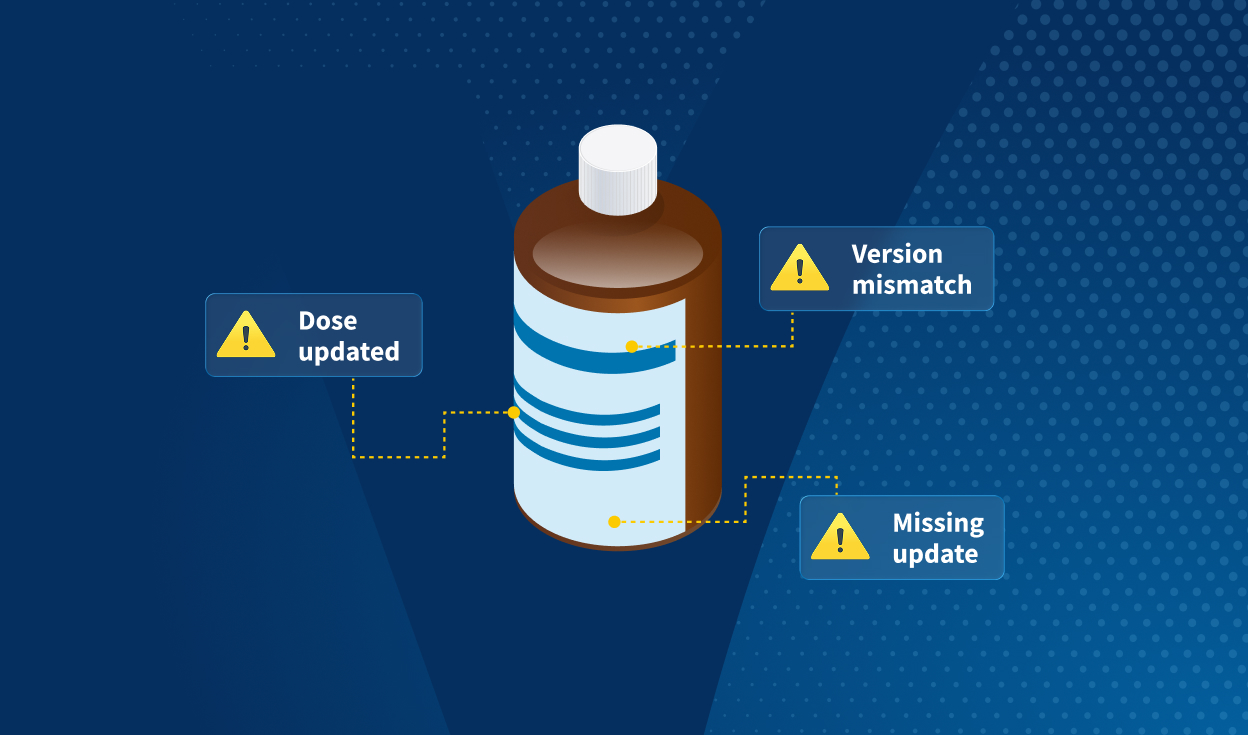


Table of contents

A step-by-step guide to managing clinical and regulatory content
Managing labeling in biotech isn’t a single handoff — it’s a continuous process that spans clinical development, regulatory submissions, packaging design, translation, and final release. And unlike traditional pharma, biotech teams are often doing all of this at speed, with lean teams, across multiple geographies simultaneously.
When the workflow works, you move from clinical data to approved, market-ready labeling efficiently and without errors. When it breaks down — as it frequently does with manual processes — the consequences range from costly revision cycles to regulatory rejections and patient safety risks.
This guide walks through every stage of the biotech labeling workflow, where the most common failure points are, and how high-performing teams are building processes that scale.
What is a biotech labeling workflow?
A biotech labeling workflow is the end-to-end process through which clinical data and regulatory content is transformed into approved labels, packaging materials, patient information leaflets, and Instructions for Use (IFUs) — across every format, language, and market a product reaches.
The workflow begins the moment a clinical protocol is developed and ends only when updated materials are in the hands of patients, healthcare providers, and regulators. In between, content passes through multiple teams, formats, and review cycles.
Where biotech labeling workflows differ from traditional pharma is in their pace and structure:
- Faster cycles. Biotech products often move from Phase I to approval in compressed timelines. Labeling must keep pace with rapid protocol changes.
- More frequent updates. Dosage amendments, new safety data, and indication expansions mean labeling is never truly static.
- Clinical-first workflows. In biotech, labeling is often built directly from clinical data in real time — not adapted from an existing commercial product. That makes the clinical-to-label transition a higher-risk step.
Key stakeholders in biotech labeling workflows
One of the defining challenges of biotech labeling is the number of teams involved — each working in different systems, on different timelines, with different definitions of “approved.”
- Regulatory Affairs — owns compliance requirements, submission content, and regulatory strategy across markets
- Clinical teams — generate source data and manage protocol documentation that drives labeling content
- Medical writing — translates clinical data into structured regulatory documents (SmPC, PIL, IFU, clinical study reports)
- Packaging and artwork teams — embed approved text into design files for physical and digital packaging
- External vendors — CROs managing trial sites, translation agencies handling multilingual materials, and print suppliers producing final artwork
Each stakeholder is a potential failure point when content moves between them without structured handoffs, shared systems, or automated verification.
Biotech Regulatory Compliance
Manual proofreading doesn’t scale with faster R&D. Here’s how high-growth biotech teams are replacing error-prone workflows with systematic verification and staying audit-ready.
The Biotech labeling workflow: step by step
Understanding each stage of the workflow — and where risk accumulates — is the foundation for building a process that holds up under regulatory scrutiny.
Step 1: Clinical Data and Protocol Development
- The protocol establishes the source of truth: indication, dosage, administration route, contraindications, and safety profile.
- Initial labeling content is defined here — even before it’s formalized into regulatory documents.
- Changes at this stage have downstream consequences across every subsequent step.
Step 2: Regulatory Document Creation
- SmPC, PIL, IFU, and trial documentation are authored based on approved clinical content.
- Version control becomes critical here: multiple documents must remain synchronized as the protocol evolves.
- Regulatory submissions in different markets may require format variations of the same core content.
Step 3: Content Adaptation for Labeling
- Approved clinical and regulatory content is adapted into the specific formats required for labels, carton text, and patient-facing materials.
- This conversion step — often done manually through copy-paste — is where content errors most commonly originate.
- Format changes (Word to PDF to XML) compound the risk of undetected discrepancies.
Step 4: Multilingual Translation
- All materials must be translated into required languages while preserving regulatory intent — not just linguistic accuracy.
- This is a high-risk stage: data drift occurs when translated content diverges from the approved source without being flagged.
- Many-to-one relationships (one source document, many language versions) make manual consistency checks impractical at scale.
Step 5: Artwork and Packaging Design
- Approved text is embedded into design files (PDF, AI) for physical and digital packaging.
- Visual layout changes — resizing, reformatting, reflowing text — can introduce discrepancies between approved content and the final file.
- Text-in-image formats create additional verification challenges that standard proofreading cannot catch reliably.
Step 6: Review and Approval (MLR / QA)
- Medical, Legal, and Regulatory (MLR) review involves multiple stakeholders, each potentially working from different document versions.
- Sequential review creates bottlenecks; parallel review without version control creates confusion.
- This stage is frequently where errors from earlier steps are discovered — at significant cost in time and revision cycles.
Step 7: Final Verification Before Release
- The critical control point: a systematic comparison of source content against final artwork across all language versions.
- Source vs. final artwork verification confirms every piece of approved content appears correctly in the release-ready file.
- Without automated verification, this step relies on human proofreading — which is inconsistent and unscalable.
Step 8: Distribution and Updates
- Post-release, labeling must be updated for trial protocol changes, safety updates, and new regulatory guidance.
- Each update triggers a new cycle through some or all of the preceding steps.
- Without a repeatable, documented process, each update cycle carries the same risks as the original workflow.
Where biotech labeling workflows break down
Despite the best intentions of the teams involved, labeling workflows fail in predictable ways. Understanding the structural failure points is the first step to addressing them.
- Manual cross-checking between formats. Comparing a Word document to a PDF to an XML file manually is time-consuming, error-prone, and doesn’t scale.
- No synchronization between teams. When clinical, regulatory, and artwork teams work in separate systems with no integration, content is copied, reformatted, and handed off without any consistency check.
- Version confusion across clinical and packaging. When there is no single source of truth, approved content and in-progress content become indistinguishable.
- Late detection of errors. In manual workflows, discrepancies are most often found at final review or artwork approval — when fixing them requires restarting significant portions of the process.
How to optimize your biotech labeling workflow
Improving a labeling workflow isn’t about adding more review steps — it’s about redesigning the process so that errors are caught earlier, handoffs are controlled, and verification is systematic rather than incidental.
- Create a single source of truth. All approved content should live in one controlled location. Every downstream document, label, and translation draws from that source. When it changes, every dependency is immediately visible.
- Enable parallel review, not sequential. Structured parallel review — where multiple stakeholders review simultaneously with clear version control — compresses timelines without sacrificing rigor.
- Integrate your systems. Regulatory Information Management (RIM) systems, Digital Asset Management (DAM) platforms, and artwork tools should share data rather than operate in silos.
- Automate verification at every stage. Build automated verification into each workflow stage — clinical-to-label, translation, and artwork — rather than relying on a single manual check at the end.
A dedicated verification layer sitting across your workflow — connecting clinical content to final artwork — is what closes the gap that standalone point tools leave open. Comparison and verification shouldn’t be a one-time step; they should be built into every content transition.
Benefits of an optimized biotech labeling workflow
When labeling workflows are structured, integrated, and automated, the benefits compound across the entire product lifecycle.
- Faster clinical-to-market timelines. Fewer manual steps and earlier error detection mean fewer revision cycles and more predictable submission schedules.
- Fewer revision cycles. Catching discrepancies at the clinical-to-label stage rather than during artwork approval drops the cost and time of correction dramatically.
- Reduced compliance risk. Systematic verification at every stage reduces the probability of submitting documents with labeling inconsistencies or missing safety content.
- Audit-ready documentation. Automated workflows generate a complete, timestamped record of every content change, approval, and verification — exactly what 21 CFR Part 11 and EU Annex 11 require.
- Scalable global launches. Multilingual verification and integrated systems mean scaling to new markets doesn’t require proportionally scaling your team.
Optimize your biotech labeling workflow from clinical data to final artwork
A labeling workflow that works is one where every content transition is controlled, every change is traceable, and every final document is verified against the approved source — automatically, at every stage.
Whether you’re managing a single Phase II trial or scaling a global launch across multiple markets and languages, the foundation is the same: structured handoffs, integrated systems, and automated verification at every step.
What is a biotech labeling workflow?

A biotech labeling workflow is the end-to-end process for transforming clinical and regulatory content into approved labels, packaging, and patient materials across all required formats and languages. It spans from initial protocol development through translation, artwork, review, and post-release updates.
How do biotech companies manage clinical-to-label transitions?
The clinical-to-label transition is typically managed through medical writing, regulatory review, and content adaptation. High-performing teams use automated comparison tools to verify that label content accurately reflects approved clinical data, flagging discrepancies before they reach the packaging or submission stage.
What are common bottlenecks in biotech labeling workflows?
The most common bottlenecks are sequential review processes, manual format conversions between clinical documents and packaging materials, and late-stage error detection that triggers full revision cycles close to submission deadlines.
How can automation improve biotech labeling workflows?
Automation improves labeling workflows by enabling systematic content comparison at every stage, clinical to label, source to translation, approved text to final artwork. It removes reliance on human proofreading for consistency checks, generates audit-ready documentation automatically, and makes it possible to scale to new languages and markets without proportionally increasing manual review effort.
Book a demo