How to ensure accuracy in pharmaceutical submissions
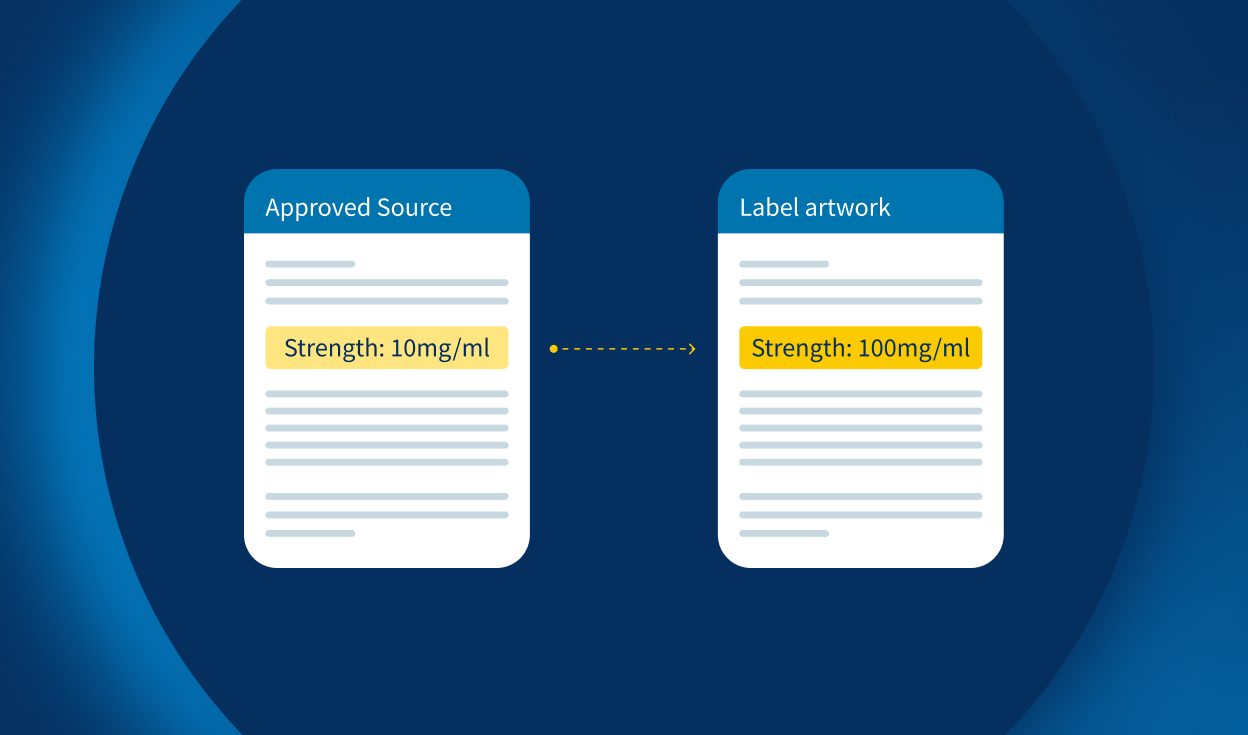


Table of contents

For regulatory affairs teams preparing dossiers, labeling, and CTD/eCTD modules for health authority review.
Key takeaways
- Accuracy means consistency. Every module, label, and translated version needs to match its approved source. A document can be correct on its own and still be inconsistent with the rest of the submission.
- Most deviations aren’t typos. They’re drift. A labeling claim no longer matches the dossier. A translated SmPC shifts in meaning. A data point differs between modules.
- Inconsistencies cost you time. Refuse-to-file decisions, deficiency letters, and clinical holds often trace back to accuracy gaps, not missing data.
- Purpose-built verification catches what manual review misses. That includes cross-document and cross-language deviations that standard comparison tools don’t pick up.
What does “accuracy” mean in a regulatory submission?
It means every document says the same thing as its approved source.
A submission is made up of dozens of documents: clinical study reports, labeling text, module summaries, and translated versions for each market. Each one can be well-written and still be inaccurate. All it takes is labeling text that drifted from the dossier, or a translated module that no longer matches the source.
"Submission accuracy is not just a module but the total dossier and it's equivalents in the markets being submitted to say the same thing. Add in the back and forth with the regulators, you have ten versions of the documents and finding the difference between the first dossier and accepted submission is painstakingly long and cumbersome, if done manually."
Vineed Ravindranath
Regional Sales Director, Schlafender HaseWhy submission accuracy matters
You avoid refuse-to-file decisions and deficiency letters. Regulators can reject submissions with inconsistencies before substantive review even begins. A mismatch between what the labeling claims and what the clinical data supports is one of the most common triggers.
You protect your time-to-market. Every deficiency letter means another resubmission cycle. When competitive timing matters, or patients are waiting, that delay costs more than the rework itself.
You keep multi-market complexity under control. A dossier prepared for one health authority often needs to be translated, reformatted, or restructured for others. Each adaptation is one more place where drift can creep in. With digital formats like FHIR-based ePI now entering the picture, the number of versions you need to keep aligned keeps growing.
Where submission deviations come from
Cross-module inconsistency. CTD/eCTD submissions are modular by design. The same fact, such as a dosing instruction or safety statement, can appear in several modules. Update one and miss another, and the submission contradicts itself.
Labeling drift from the dossier. Labeling text should reflect what’s approved in the dossier. Over many revision cycles, label language can quietly move away from the underlying data. Nobody notices until a reviewer does.
Translation drift. A dossier that’s accurate in its source language can lose accuracy in translation. It’s rarely an obvious mistranslation. It’s a subtle shift in meaning that changes what’s being claimed.
Version control over a long review cycle. Submissions evolve over months, sometimes years. Working from an outdated module, or missing that an earlier module needs to match a later change, is common. It’s also avoidable.
See how Pharma 5’s regulatory affairs team checks multilingual legal mentions in 15 minutes instead of 12 hours.
Most submission deviations aren’t typos. They’re drift between modules, labels, and translations. Here’s how regulatory affairs teams catch inconsistencies before health authorities do.

How to build accuracy into your submission process
The teams with the fewest deficiency letters don’t rely on one big final review. They verify at every stage, before anything moves forward:
- Compare labeling against the dossier to catch drift early.
- Compare translated modules against the source for every language pair.
- Compare each new version against its approved predecessor so no change goes unaccounted for.
Manual comparison catches the obvious deviations. It reliably misses Unicode-level differences, subtle translation shifts, and inconsistencies buried deep in long documents. For a broader look at building checks into your process, see our guide on how to reduce labeling errors and prevent recalls in regulated industries.
How TVT supports pharmaceutical submission accuracy
TVT compares content across formats and languages, including Word, PDF, XML, and SPL. It catches what others miss.
Accuracy. Spot every deviation between labeling text and dossier content before you submit. Verify translated modules against the source in any language pair, down to the character level.
Workflow efficiency. Compare across disconnected files and versions without copying content between systems. Your reviewers focus on the differences that matter, not on hunting for them.
Proof and protection. Every check produces a complete, audit-ready comparison report that supports 21 CFR Part 11 and EMA Annex 11 requirements. Learn more about how automated proofreading supports FDA, EMA, and 21 CFR Part 11 compliance.
“When an inspector asks how you know the label matches the dossier, ‘we checked it carefully’ isn’t a great answer. A timestamped comparison report is. That’s often the moment teams realize verification is about protection as much as accuracy.”
— Philipp Thomas, Regional Sales Director, Schlafender Hase
Working on the artwork and packaging side of the same problem? Read what tools verify regulatory-compliant artwork and label content, or see how TVT works for pharmaceutical teams.
Keep reading
Quick answers to the questions regulatory affairs teams ask most about keeping submissions accurate and consistent.
How can I ensure accuracy in pharmaceutical submissions?

Verify at each stage instead of relying on one final review. Compare labeling against the dossier, translated content against the source, and each version against its predecessor. Purpose-built comparison software catches drift that manual review misses.
What causes most regulatory submission deviations?
Drift, not typos. The most common failure points are a labeling claim that no longer matches the dossier, a translated module that has shifted in meaning, and a data point that’s inconsistent across CTD modules.
Can translation affect submission accuracy?
Yes. A dossier can be accurate in its source language and still lose accuracy in translation through subtle shifts in meaning. These deviations are among the hardest to catch manually.
How do I choose the right verification software?
Start with the formats and languages you work in, your compliance requirements, and how the tool fits your existing review workflow. Our buyer’s guide to content verification software for regulated industries walks you through the key questions.