FMCG & CPG labeling workflow: how to manage multi-market label updates step by step


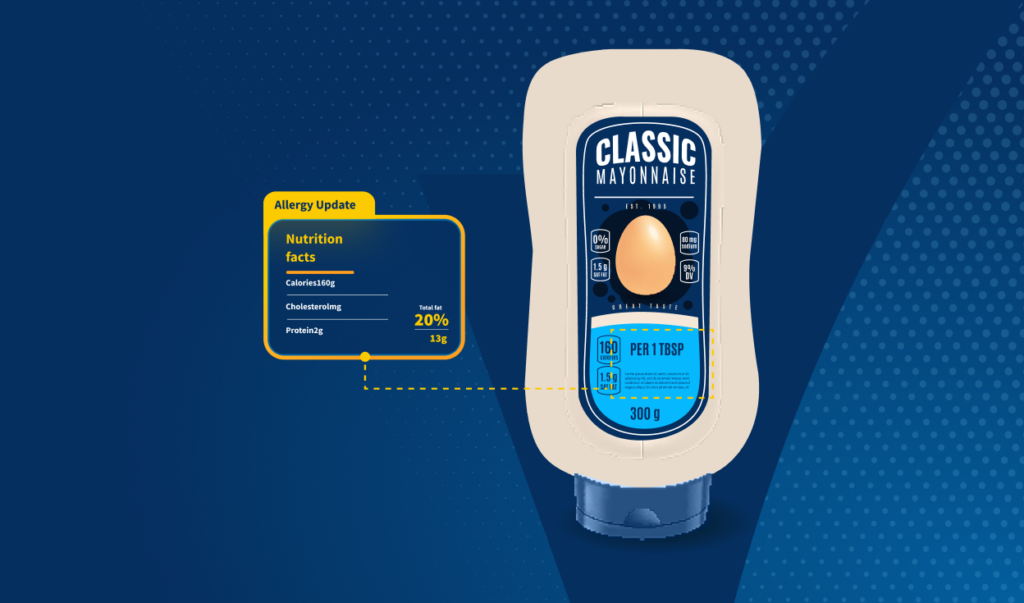

Managing packaging labels across multiple markets has become one of the most operationally complex challenges in CPG and FMCG artwork teams. A single product can require dozens of label variants — each adapted for different languages, regulatory frameworks, allergen disclosure rules, and regional claim standards. And when something changes upstream — a reformulation, a regulatory update, a new market entry — that change doesn’t affect one file. It ripples across packaging specs, artwork files, regulatory submissions, digital assets, and printed proofs simultaneously.
Most labeling failures don’t happen because teams aren’t careful. They happen because the workflow itself is not built to absorb the complexity. Manual handoffs, disconnected systems, and late-stage verification create the conditions for error — regardless of effort.
This guide breaks down the CPG and FMCG labeling workflow step by step: what happens at each stage, where errors typically enter, who owns what, and how modern content verification practices reduce risk across the entire process.
Why CPG/FMCG labeling workflows break down
Before mapping the workflow, its worth understanding why labeling processes fail — even in experienced, well-resourced teams.
The most common root causes are structural, not individual:
Last-minute formulation and ingredient changes are a constant in CPG and FMCG. Product development and regulatory timelines rarely align, which means artwork is often in progress before formulations are fully locked. When changes come late, they need to propagate quickly — and that’s precisely when errors slip through.
Team misalignment between regulatory, marketing, packaging, and supply chain functions creates information gaps. Each team works from its own version of the truth, and sometimes handoff protocol, as a result inconsistencies create errors that accumulate across the workflow.
Version control failures are endemic to email-based and file-share-based collaboration. When five versions of an artwork file are circulating with names like “final,” “final_v2,” and “final_approved_REAL,” the risk of working from the wrong document is high.
Manual checks at scale are simply unreliable. A human proofreader comparing a 300-word ingredient declaration across 12 regional variants will miss things. Not because they aren’t skilled — but because the task is cognitively unsuited to human review.
Late-stage error detection compounds cost. An error caught at the copy stage costs minutes. The same error caught after printing costs thousands.
The downstream consequences are serious: delayed product launches, compliance failures in regulated markets, costly artwork rework, and in the worst cases, product recalls.
The CPG/FMCG labeling workflow: step by step
The labeling process spans from initial formulation through to post-launch compliance management. Each stage has distinct inputs, outputs, and risk points. Understanding them as a connected system — not isolated tasks — is the foundation of effective workflow management.
Step 1: Product Manufacturing and Formulation
The labeling process begins before any copy is written. Formulation decisions — ingredients, allergens, nutritional profiles, processing aids — define what must appear on the label.
At this stage, the key risk is that formulation changes are made without triggering corresponding updates across all related documentation. It is common for ingredient lists in packaging specs to lag behind the actual formulation, especially when late-stage product adjustments occur under time pressure.
Best practice here is to treat any formulation change as a documentation event. Every affected document — spec sheets, technical dossiers, artwork briefs, digital content — should be flagged for review the moment a change is logged.
Content verification tools that support many-to-one and one-to-many document comparison are particularly valuable at this stage. Rather than manually checking each document, teams can run automated comparisons that surface discrepancies across all materials simultaneously — with focus applied specifically to the sections that changed.
Step 2: Copy Development
With formulation inputs confirmed (or in progress), regulatory and marketing teams develop the label copy. This includes legal declarations, nutritional information, claim language, usage instructions, and any required warnings.
For multi-market products, this stage multiplies quickly. Each market may require a different language, different mandatory statements, different claim thresholds, and different formatting conventions. A health claim approved in one jurisdiction may be restricted or prohibited in another.
The risks at copy development are primarily consistency related. For example, claims drift between versions. Allergen formatting diverges from regulatory requirements. Reading order — critical for compliance in some markets — gets disrupted during layout adjustments.
Early validation of text consistency across all language versions and market variants prevents these issues from compounding downstream. Automated text comparison tools can check for claim deviations, formatting inconsistencies, and country-specific compliance gaps across every version in parallel — a task that is prohibitively time-consuming to do manually at scale.
Step 3: Artwork Development
Approved copy moves to packaging design, where text is embedded into artwork, visual hierarchy is established, and functional elements — barcodes, QR codes, recycling symbols, certification marks — are placed.
This is one of the highest-risk stages in the entire workflow. Design tools do not enforce content integrity: text gets resized, rephrased, or inadvertently altered during layout. Multi-language layouts introduce additional complexity, particularly for right-to-left languages or scripts with complex character rendering.
A common and costly failure pattern: copy is approved at Step 2, but the version embedded in artwork at Step 3 reflects an earlier draft. By the time the discrepancy is caught, production timelines are already under pressure.
Best practice is continuous verification throughout artwork development — not a single review at the end. Automated artwork verification tools can compare embedded text against approved copy at any point in the design process, flagging alterations, missing elements, and language inconsistencies. Capabilities that matter most here include curved and angled text recognition (common on flexible packaging), multi-language character validation, and automated barcode and QR code integrity checks.
Step 4: Internal Review and Approval
Once artwork is developed, it enters a structured review cycle involving regulatory affairs, legal, marketing, and quality functions — sometimes also including supply chain and senior leadership for high-profile launches.
The challenge at this stage is coordination. Multiple stakeholders review in parallel, generating conflicting feedback. New versions are issued to address comments, but not all reviewers receive or acknowledge each version. Approval chains become difficult to track.
The result is often a situation where artwork is progressed under the assumption it has been approved, when in fact outstanding comments remain unresolved.
Centralised review management — with a single version of record, tracked annotations, and clear approval status — eliminates the ambiguity that manual email-based review creates. Automated comparison between submitted and revised versions confirms that all feedback has been correctly addressed before the file advances.
Step 5: Pre-Press and Printer Proofs
As artwork moves toward production, it passes through pre-press processing and the generation of printer proofs. This stage introduces a new category of risk: errors that originate not from content decisions but from technical production processes.
Font substitution, text reflow, element displacement, barcode degradation, and colour profile conversion can all introduce discrepancies between the approved artwork and the file actually sent to press. These changes are often subtle — a character dropped from an ingredient list, a barcode that fails to scan — but their impact is significant.
Comparing printer proofs against approved artwork on a character-by-character basis is essential. Automated verification tools that generate annotated comparison reports make this process fast and auditable, and support the rapid back-and-forth that pre-press timelines typically demand.
Step 6: Printing and Production
Once proofs are approved, packaging is produced at scale. Any error that has survived to this stage now becomes a volume problem. The cost of catching a labeling error post-print is orders of magnitude higher than catching it earlier in the process.
This is why verification earlier in the workflow is not just a quality practice — it is a cost control measure. Every hour invested in rigorous copy, artwork, and proof verification reduces the probability of a production-stage error that requires reprinting or, in serious cases, a market withdrawal.
Step 7: Market Adaptation and Localisation
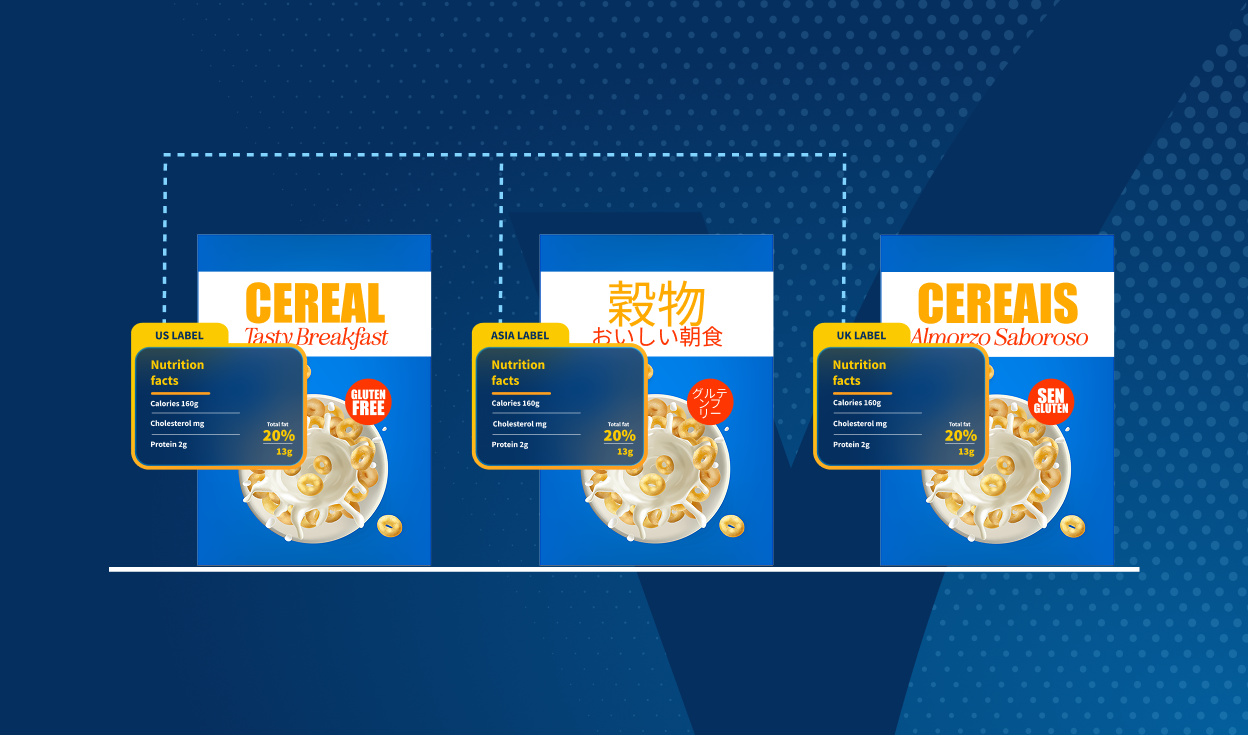
For products entering multiple markets, localisation runs parallel to or following the core workflow. Country-specific variants are produced by adapting the approved master artwork: translating text, adjusting mandatory declarations, replacing market-specific claims, and updating regulatory symbols.
Each adaptation introduces independent risk. Translations may diverge from approved terminology. Local regulatory requirements may have been incompletely captured in the brief. Market-specific formatting rules — mandatory font sizes, declaration placement, nutrition table formats — may not have been applied correctly.
A single source of truth — a master approved artwork against which all market variants are systematically verified — is the most reliable way to maintain consistency at scale. Automated comparison of each market variant against the master surfaces deviations without requiring manual review of every element in every version.
Step 8: Post-Approval Changes and Ongoing Updates
Labeling is not a one-time activity. Regulatory changes, ingredient reformulations, claim updates, and packaging redesigns require ongoing management. In some categories, the frequency of label updates can be substantial.
The risk here is that updates are applied inconsistently — correctly in some markets or some materials but missed in others. Without a structured change management process, labeling compliance degrades over time, and the effort required to audit and remediate the portfolio grows steadily.
Treating labeling as a continuous workflow — rather than a project with a defined end — changes how teams allocate resources and design their processes. Automation plays a particular role here: regular, systematic verification of all live materials against current approved masters creates the audit-ready records that regulators and internal compliance functions increasingly require.
The FMCG artwork rabbit hole: how to get packaging right first time
Learn how to prevent FMCG packaging artwork errors, reduce rework, and get it right first time. Watch the on-demand webinar with expert insights.
Who owns the CPG and FMCG labeling workflow?
Labeling is a cross-functional responsibility, and most failures occur not within a team but between them. Defining ownership clearly reduces the risk of things falling into the gaps.
Regulatory affairs teams own compliance accuracy. They are responsible for ensuring that all mandatory declarations, claims, and disclosures meet the requirements of each target market, and that regulatory approvals are obtained and documented.
Marketing teams own claim language and brand messaging. They define the copy that differentiates the product in market and are responsible for ensuring that claims are substantiated and consistent across all channels.
Packaging and artwork teams own design execution. They translate approved copy into production-ready artwork and manage the technical aspects of pre-press and print file delivery.
Quality and QA teams’ own verification and control. They are responsible for confirming that final outputs match approved inputs, and for maintaining the records that demonstrate compliance.
External partners — translation agencies, design studios, printers, co-manufacturers — execute significant portions of the workflow, often without full visibility into the constraints that govern it. Clear briefing, structured handoffs, and systematic verification of their outputs are essential.
The practical implication is that effective labeling governance requires cross-functional coordination mechanisms: shared version control, defined approval workflows, and verification checkpoints that span team boundaries — not just individual quality gates within each function.
Where workflows typically break down
Even well-designed processes develop failure points over time. The most common are:
Siloed teams and disconnected systems. When regulatory data lives in one system, artwork files in another, and approval records in email threads, the risk of inconsistency is structural. Teams cannot verify what they cannot see.
Manual proofreading as the primary control. Human review is valuable, but it is not a scalable verification strategy. It is slow, inconsistent, and disproportionately error-prone under time pressure — precisely the conditions under which most label reviews occur.
Lack of version control. Without a definitive record of which version is current and approved, any version can inadvertently enter the workflow. The problem compounds when multiple markets are in play simultaneously.
No structured verification step between stages. Many labeling workflows include review but not verification — the former being a judgement call, the latter being a systematic comparison against a defined standard. Verification checkpoints between each major stage are what prevent errors from advancing.
Late-stage error detection. When the first rigorous check occurs at the pre-press or proof stage, any errors found require rework across all upstream materials. Early verification — at copy development and initial artwork stages — is substantially cheaper.
Manual vs. Automated Labeling Workflows |
||
|---|---|---|
| Process Step | Manual Workflow | Automated Workflow |
| Document checks | Manual comparison, line by line | Automated multi-file verification with deviation reporting |
| Artwork review | Visual inspection by proofreader | Text and artwork validation with character-level accuracy |
| Version control | Email threads and shared drives | Centralised system with tracked change history |
| Error detection | Late-stage, often under time pressure | Early and continuous, at each workflow stage |
| Compliance tracking | Manual documentation, difficult to audit | Audit-ready records generated automatically |
| Multi-market variants | Reviewed independently, inconsistently | Systematic comparison against master across all variants |
| Pre-press verification | Proof reviewed visually | Automated comparison with annotated deviation report |
"TVT is used daily with us and makes our work much easier. I have never heard of any problems from my colleagues since implementing TVT. Really an excellent product!"
Patric Bodmer
Head of Regulatory Affairs, Ricola Ltd.The difference in outcome is not marginal. Teams operating automated verification workflows consistently detect more errors earlier, complete review cycles faster, and maintain audit documentation with significantly less administrative overhead.
How Automation Improves CPG and FMCG Labeling Workflows
Content verification software does not replace the expertise of regulatory, marketing, and quality teams. It operates as a control layer that makes their work more reliable and more efficient.
The practical benefits are substantial:
Earlier error detection means lower remediation costs. An error flagged at copy development requires a text correction. The same error flagged at the pre-press stage requires artwork rework, re-approval, and potentially reprinting.
Consistency across markets is mechanically enforced rather than dependent on the attention of individual reviewers. Automated comparison of all market variants against a master artwork surfaces deviations that manual review routinely misses.
Faster review cycles result from replacing sequential manual checks with parallel automated verification. Annotation reports direct reviewer attention to actual discrepancies rather than requiring full re-reads of every element.
Audit readiness is built into the process rather than assembled retrospectively. Automated verification logs create the records that regulatory inspections and internal compliance audits require, without additional administrative effort.
Scalable operations become achievable. As product portfolios and market footprints grow, manual verification does not scale. Automation enables labeling teams to handle increased volume without proportional increases in headcount or cycle time.
For CPG and FMCG businesses looking to implement or evaluate content verification tooling, Schlafender Hase’s content verification software for FMCG packaging provides purpose-built capabilities across the full labeling workflow, including multi-language text verification, artwork comparison, barcode validation, and integration with existing approval management systems. The TVT Workflow details how these capabilities are applied at each stage of the process.
Key Takeaways
CPG and FMCG labeling is a multi-stage, multi-team workflow — and most risk lives in the handoffs between stages, not within them.
Reactive processes — where verification happens late and remediation happens under time pressure — are not sustainable at scale. The cost of errors increases at every stage they advance through, and the frequency of changes in a typical CPG and FMCG portfolio means errors are a structural feature of the process, not an anomaly.
The labeling teams that manage this complexity most effectively share common characteristics: clear cross-functional ownership, structured verification checkpoints at each stage, version-controlled systems of record, and automation that handles systematic comparison so that human expertise can be focused on judgement calls rather than pattern-matching.
Structured workflows and content verification automation are not optional upgrades for high-performing labeling operations. They are the foundation that makes compliance, speed, and scalability achievable simultaneously.
What is an CPG/FMCG labeling workflow?

An CPG/FMCG labeling workflow is the end-to-end process through which product label content is created, verified, approved, and adapted for packaging production. It spans from initial formulation and copy development through artwork creation, internal review, pre-press verification, printing, market localisation, and ongoing compliance management. Effective workflows include defined ownership, structured handoffs between teams, and verification checkpoints at each stage.
How do companies manage multi-market label updates?
Multi-market label management requires a single source of truth — typically a master approved artwork — against which all market variants are systematically verified. Best-practice operations use automated content verification tools to compare each localised version against the master, surfacing deviations in text, mandatory declarations, regulatory symbols, and formatting. This replaces the manual, market-by-market review process that is both slow and prone to inconsistency.
What are the biggest risks in labeling workflows?
The highest-risk points are late-stage formulation changes that are not propagated across all materials; text alterations during artwork development; version control failures resulting in outdated files entering the approval chain; and insufficient verification at the pre-press stage before production. Labeling failures that reach print represent the costliest category, as they require rework or reprinting at scale.
How can automation improve labeling accuracy?
Content verification automation improves accuracy in three primary ways. First, it applies consistent, objective comparison criteria — character-level text matching, barcode integrity checks, image element validation — that human reviewers apply inconsistently under time pressure. Second, it enables verification at every stage of the workflow, not only at designated review points, so errors are caught earlier and more reliably. Third, it generates audit-ready records of every verification performed, supporting regulatory compliance and internal governance requirements without additional documentation effort.
Further Reading:
Labeling compliance in regulated industries: the complete guide – Schlafender Hase
How FMCG and CPG companies can improve regulatory risk management for packaging – Schlafender Hase
Ensure compliance with the latest cosmetic trends and regulations – Schlafender Hase
The ripple effect: understanding the full impact of FDA’s new nutrition labeling – Schlafender Hase