Content verification software for pharma advertising: a practical guide
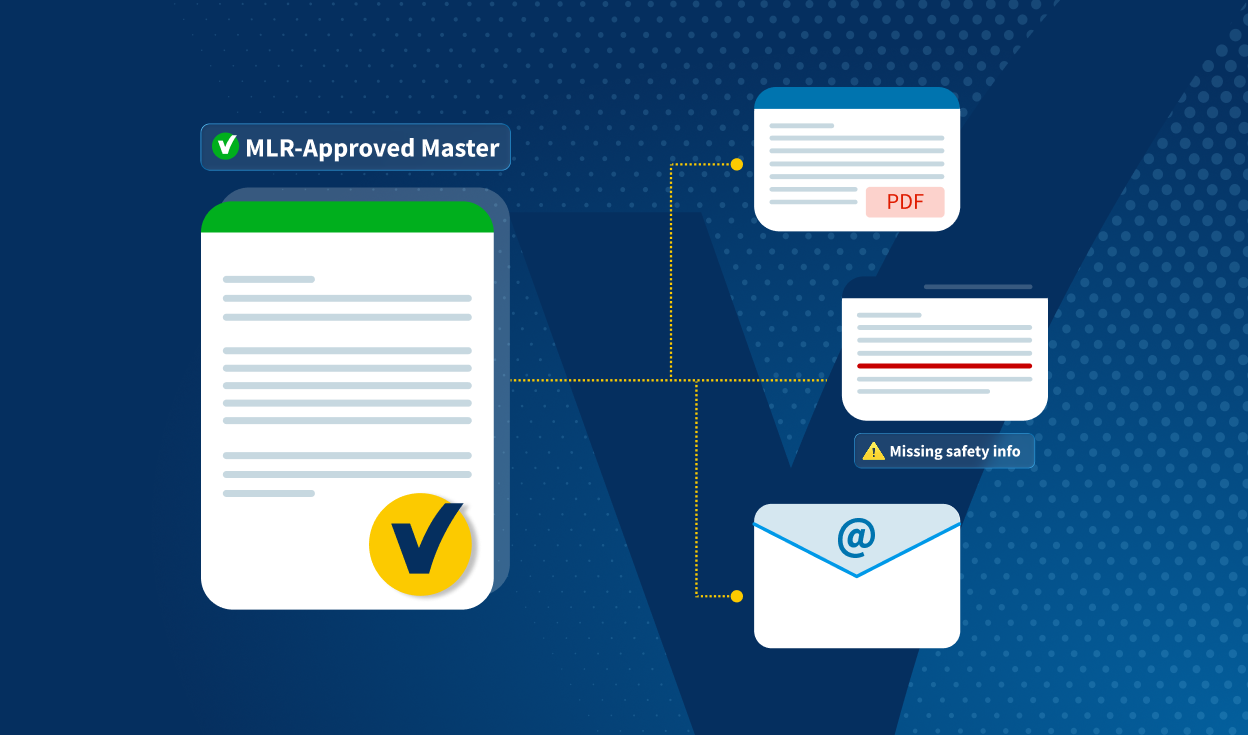


Table of contents

Picture this: your drug launches in three weeks. The promotional materials have cleared MLR review. Design has finalized the detail aid, the website is live, and the sales team is trained. Then someone spots a discrepancy. A contraindication from the approved labeling is missing from the site. Not removed deliberately — just dropped in a layout revision nobody flagged.
Three weeks out from launch, that’s not a minor edit. That’s a full review cycle, a potential delay, and a compliance event to document.
This is the scenario content verification software exists to prevent. Here’s how it works, why it matters for advertising and promotion specifically, and what to look for when evaluating a solution.
What is content verification software?
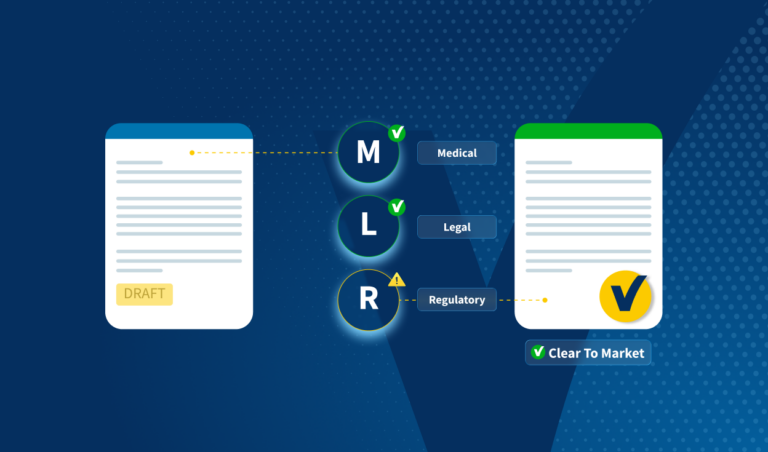
Content verification software compares two documents, or a document and a live digital source and flags every deviation between them. In a pharmaceutical advertising and promotion context, that typically means comparing the MLR-approved master against downstream deliverables: designed PDFs, websites, email templates, slide decks, print proofs.
The comparison is character-by-character for text and pixel-by-pixel for images. It detects differences that are invisible to a tired reviewer on pass four of a dense document: a transposed digit in a dosage figure, a changed spacing that alters how a safety warning reads, a symbol substituted by a font rendering issue, placeholder copy that wasn’t deleted before handoff.
Critically, it works across formats. An approved Word document can be compared against a final PDF. An approved PDF can be compared against a printer’s proof. An approved copy document can be compared against a live website via URL. Format changes, the inevitable transformations that happen as content moves from authoring to design to production to digital, don’t obscure the comparison.
Why manual proofreading isn't enough
Manual proofreading is not a failed approach. It’s a necessary part of the review process. What it can’t be is the only systematic check against approved content.
The limitations are well-documented. Human attention degrades over the course of a long document. Reviewers experienced with a piece of content are prone to reading what they expect to see rather than what’s actually there, a well-established cognitive bias that affects even skilled professionals. And the volume of promotional materials that a typical pharmaceutical company produces is substantial: multiple adaptations of core content across channels, languages, and markets, all needing verification against approved labeling.
The Tank Worldwide QC team put it clearly: the goal of automating proofreading was to “take the mechanical element of word-for-word, number-for-number proofreading off the plate of the team” so reviewers could focus on higher-value judgement calls, messaging consistency, readability, accessibility. TVT handled the mechanical verification. The reviewers handled everything that requires human judgement.
That division of labour is more than an efficiency gain. It’s a risk management decision. The mechanical comparison — does this text match the approved text, exactly? — is a task where software is more reliable than humans. The contextual judgement — does this framing create a misleading impression even though the words are technically accurate? — is a task where humans are essential. Combining both gives you a stronger review process than either alone.
What to look for in content verification software for pharma advertising
Not all comparison tools are equivalent. Generic document comparison features in word processors or PDF tools can surface some differences, but they weren’t designed for the requirements of pharmaceutical promotional review. Here’s what matters:
Cross-format comparison. Pharma promotional materials routinely move between Word, PDF, InDesign, HTML, and other formats. Your verification tool needs to handle any format-to-format comparison — including comparing a digital file against a live URL — without losing fidelity.
Character-level text comparison. The FDA’s consistency requirements are exacting. A comparison tool that catches paragraph-level differences but misses a transposed digit or a changed unit of measurement is not fit for purpose in this context. Look for Unicode-based, character-by-character comparison.
Image and artwork verification. Promotional materials contain more than text. Graphics, charts, dosage tables, and brand imagery all need verification. Pixel-level artwork comparison catches changes that text-only tools miss entirely.
Barcode verification. For pharmaceutical packaging that feeds into promotional materials, barcode readability and accuracy is a compliance requirement in its own right. A solution that includes barcode grading — against GS1 and other standards — closes a verification gap that separate tooling often introduces.
Audit trail and reporting. In a regulated environment, being able to demonstrate what was compared, when, by whom, and what was found is as important as catching the deviation in the first place. Your verification tool should generate reports that can be filed as part of the promotional review record.
Workflow integration. Verification software that requires a separate login, a manual export step, or a specialist operator is verification software that gets skipped when timelines are tight. The best implementations integrate directly into the existing content management or artwork management workflow.
Validation support. Pharma companies operating under GxP requirements need software validation packages for tools used in regulated processes. A solution designed for the industry should have this available as standard.
The Pharma promotional review process: how to build a compliant MLR workflow
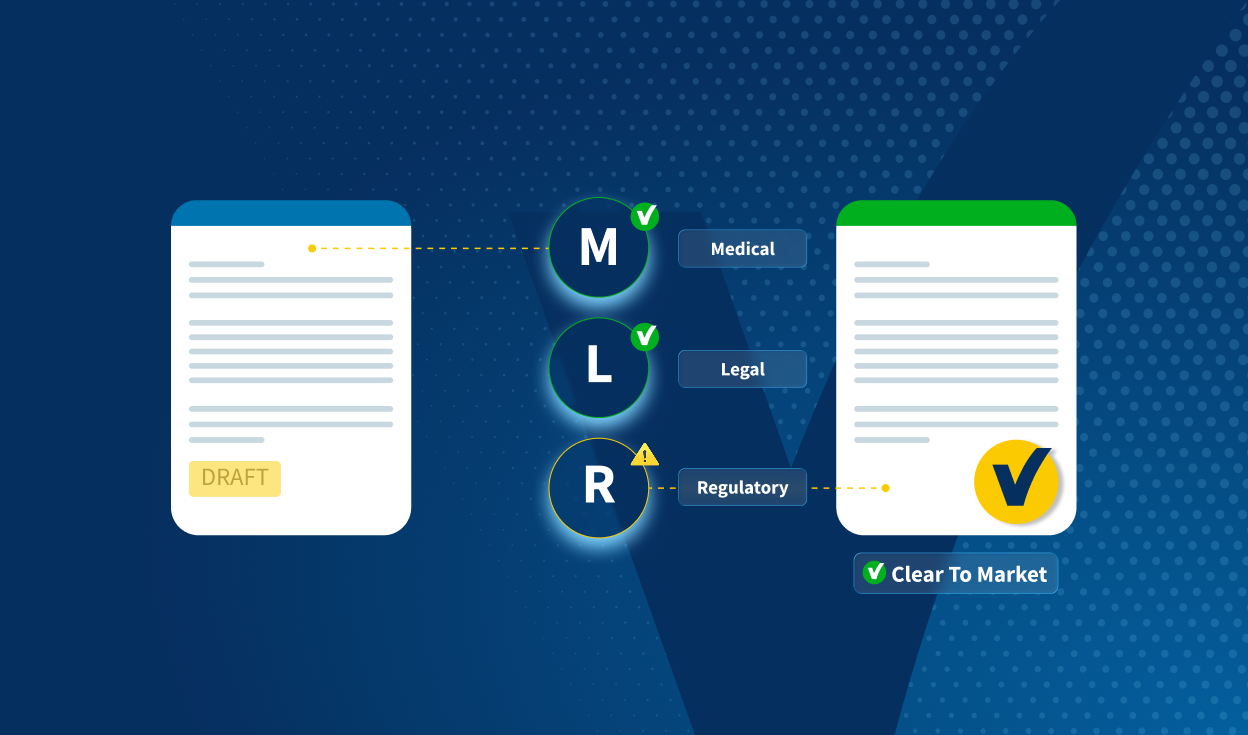
The MLR review process is your first line of defense against off-label claims and FDA enforcement action. But most organisations have gaps and they tend to appear downstream, not at the initial sign-off stage.
TVT in advertising and promotion: how it works in practice
TVT content verification software was built for exactly this environment. Here’s how a typical promotional verification workflow looks with TVT:
A pharmaceutical company develops a microsite to support a prescription drug launch. Core content is drafted and approved by the MLR committee in Word format. A digital agency builds the site. Before the site goes live, the content manager compares the live URL against the approved Word document using TVT, by simply pasting the URL into the comparison interface.
TVT loads the site content and compares it against the approved document. Every deviation is highlighted: a missing sentence, a reordered list, a changed number, an image that doesn’t match the approved artwork. The content manager annotates the deviations, assigns corrections, and generates a report that becomes part of the review record. The agency makes the corrections. A second comparison confirms they’ve been made.
The same process applies to print materials. When the printer returns proofs, TVT compares the PDF proof against the approved artwork file. Changes made during pre-press, however small, however unintentional, are surfaced. As one TVT customer put it: “We have one hard and fast rule: no change should be made without our approval. We can see any changes at a very fine level now — ones that might have gone unnoticed before.”
For organisations operating across multiple languages and markets, TVT’s Unicode-based comparison handles any language, including right-to-left scripts. Market-specific adaptations can be verified against both the global approved content and any locally approved deviations.
The compliance case for verification software at scale
The business case for content verification software in pharma advertising extends well beyond individual deviation prevention. At the organisational level, it changes the risk profile of promotional activity in several ways:
Earlier detection reduces remediation cost. Catching a deviation at the design stage costs a fraction of catching it after print run or site launch. Building verification into the workflow at each major adaptation point — not just at the end — compresses the cost of correction.
Documented verification supports regulatory defence. If OPDP or an equivalent body questions a promotional piece, being able to demonstrate that it was systematically verified against approved labeling — with a timestamped report — is materially different from relying on manual review records. The audit trail is the defence.
Consistent verification builds review culture. Organisations that use systematic verification report a secondary benefit: reviewers develop better habits because they know deviations will be found. The knowledge that the comparison will be run changes how content is handled upstream.
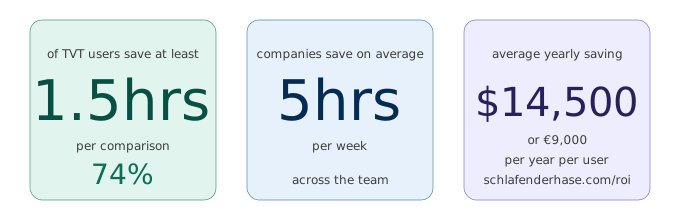
Efficiency unlocks capacity. 74% of TVT users report saving a minimum of 1.5 hours per comparison. Across a large pharma company’s promotional output, that compounds quickly — and the time saved is available for the substantive review work that only humans can do.
The detail that creates a compliance problem is usually small. A missing paragraph. A changed number. A line of placeholder text that never got deleted. Manual proofreading catches many of these — but not all of them, not consistently, and not with the kind of documented trail that regulatory scrutiny requires.
Content verification software closes that gap. Not by replacing human judgement, but by handling the mechanical comparison so that human judgement can go where it’s actually needed.
Ready to see what TVT catches in your promotional materials? Request a demo.
What types of content can content verification software compare?

Any two documents in digital form — Word, PDF, InDesign exports, PowerPoint, Excel, HTML, and others. TVT also supports direct URL comparison, enabling verification of live websites and e-labeling against approved documents.
How does TVT handle non-English languages?
TVT uses Unicode-based text comparison, which supports any language that uses a Unicode font — including right-to-left scripts such as Arabic and Hebrew, and Asian character sets. This is relevant for companies operating across multiple regulatory jurisdictions with market-specific adaptations.
Is content verification software validated for GxP use?
TVT provides software validation packages to support GxP validation requirements. This is distinct from general-purpose comparison tools that are not designed for use in regulated processes.
Can TVT be integrated with existing content management systems?
Yes. TVT can be integrated with regulatory information management systems, artwork management platforms such as Esko, and tools including Veeva. Integration means verification is built into the workflow rather than being a separate manual step.
TVT IntegrationDoes TVT only work for text comparison?
No. TVT includes modules for artwork verification (pixel-level image comparison), barcode grading, and spelling verification including industry-specific dictionaries and proprietary name checking. All three modules can be used together within a single comparison workflow.
Is content verification software relevant for medical device advertising?
Yes. Medical devices are subject to FDA regulations on misbranding and false claims, and the volume and complexity of device labeling and IFU documentation creates similar verification challenges to pharmaceutical advertising. TVT is used across pharma, medical device, FMCG, and crop science.