Off-label marketing in pharma: what it is, why it’s risky, and how to stay compliant
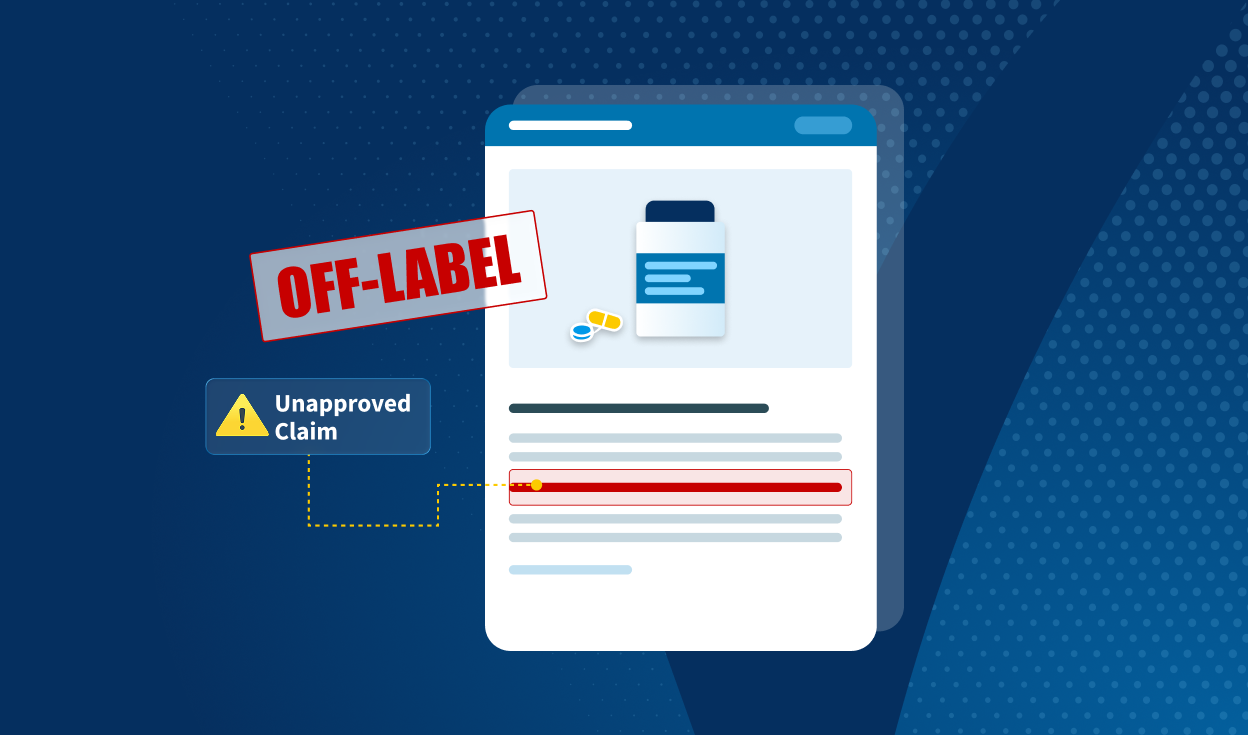



Your drug is approved and your team is ready. But somewhere between the MLR-approved copy and the final promotional piece, a single unapproved claim slips through. That’s all it takes.
Off-label marketing is one of the most serious compliance risks in the pharmaceutical industry and one of the most preventable. Here’s what it means, why the stakes are so high, and how companies across the US, Canada and globally are building better safeguards.
What is off-label marketing?
Off-label use of a drug refers to prescribing or using a treatment for conditions, patient populations, or dosages not approved by the FDA (or Health Canada, EMA, and equivalent regulatory bodies in other regions). Prescribing off-label can be legitimate, physicians do it when approved options are exhausted or absent.
Off-label marketing is a different matter entirely. Advertising or promoting a drug for uses not reflected in its approved labeling is illegal under US law, and equivalent regulations apply in Canada and across the EU. It constitutes a false claim and can trigger prosecution under the False Claims Act (FCA) because off-label promotion leads to Medicaid reimbursement claims for unapproved uses, which amounts to fraud.
It’s worth being precise about terminology here, because the FDA is. “Off-label promotion” is broader than just advertising. It includes:
- Advertising in journals, broadcast media, websites, and digital channels
- Sales representative conversations with physicians
- Speaker programs and sponsored events
- HCP communications, slide decks, and training materials
- Patient-facing materials, brochures, and direct mail
If it promotes off-label use, it falls under the FDA’s Office of Prescription Drug Promotion (OPDP) jurisdiction, regardless of format or channel.
What are the consequences?
Substantial. The largest settlement in US pharmaceutical history — GlaxoSmithKline’s $3 billion agreement in 2012 — included charges of off-label promotion. Since then, enforcement has continued at scale. Violations of the False Claims Act and off-label promotion by life science companies resulted in settlements exceeding $9 billion in 2022 alone.
The financial exposure isn’t limited to settlement costs. Companies also absorb:
- The direct cost of recalling, reworking, and re-launching promotional materials
- Delays to product promotion while remediation is underway
- Reputational damage from public warning letters and correction statements
- The legal costs of qui tam lawsuits, where whistleblowers receive a portion of recovered funds — creating a strong financial incentive for internal reporting
The FDA has also signaled in recent years that it is stepping up enforcement. Warning letters from OPDP have become more frequent and more specific, targeting not just obvious false claims but subtle inconsistencies in how approved indications are framed.
Regulators beyond the US are equally vigilant. Health Canada’s Food and Drugs Act prohibits advertising drugs for unapproved uses, while the EU’s Directive 2001/83/EC and country-level bodies like the MHRA (UK) impose similar restrictions. Companies operating across multiple markets need to manage compliance against several overlapping regulatory frameworks simultaneously.
How does the FDA determine whether promotion is off-label?
The FDA uses a three-factor test to assess whether product communications are consistent with FDA-required labeling (CFL):
Factor 1 examines whether the communication aligns with the approved indication, patient population, limitations, dosing, and directions for use. No inconsistencies or conflicts are permitted.
Factor 2 asks whether the communication increases the potential for harm to health relative to what’s in the required labeling.
Factor 3 considers whether the approved labeling directions for use still enable the product to be safely used under the conditions suggested in the communication.
The distinction between Factors 2 and 3 is subtle but important. Factor 2 is about how the communication changes the risk profile; Factor 3 is about whether the approved labeling still holds when read in the light of the communication. Both test consistency, just from different directions.
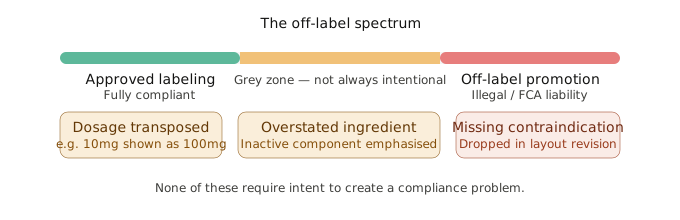
This means compliance isn’t simply a matter of avoiding explicit off-label statements. Omissions, framing choices, overstatement of a common ingredient’s role, or implicit suggestions about unapproved populations can all trigger scrutiny.
The compliance challenge: content across formats and teams
One of the most common root causes of off-label content appearing in promotional materials isn’t intentional non-compliance — it’s the sheer complexity of the promotional review and production process.
A typical promotional workflow might look like this: regulatory affairs drafts and approves core content. Marketing adapts it into a brochure, a detail aid, a website landing page, a HCP email, and a set of sales representative training slides. Each of those goes through a designer. Some go through an agency. Some get updated midway through the campaign. By the time the materials reach the field, the version trail can be difficult to follow.
Manual proofreading at each stage introduces risk. A contraindication paragraph may be trimmed for space. A dosage figure may be transposed. Placeholder text may not get deleted. None of these require bad intent to cause a compliance problem.
The FDA views all promotional materials, regardless of format, as subject to the same consistency requirements. That means the website, the trade show slide deck, and the email to physicians all need to match the approved labeling. Getting that right across every downstream format, in every market, is not a task that can be reliably managed by eye.
Faster, more accurate ISI reviews
“TVT absolutely catches things I wouldn’t have caught before. Very granular, very small details. Even whether a period has been bolded or italicized.” Matt Inman, Managing Medical Editor at Medscape, ran the time studies. The result: 40% faster reviews on average.

Building a more robust promotional review process
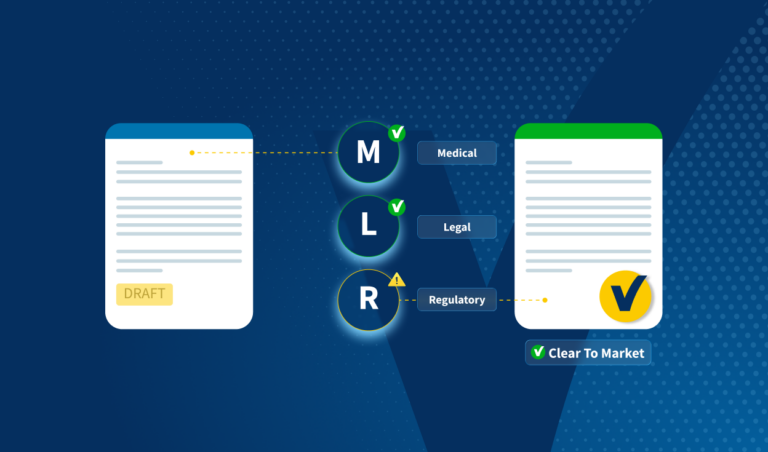
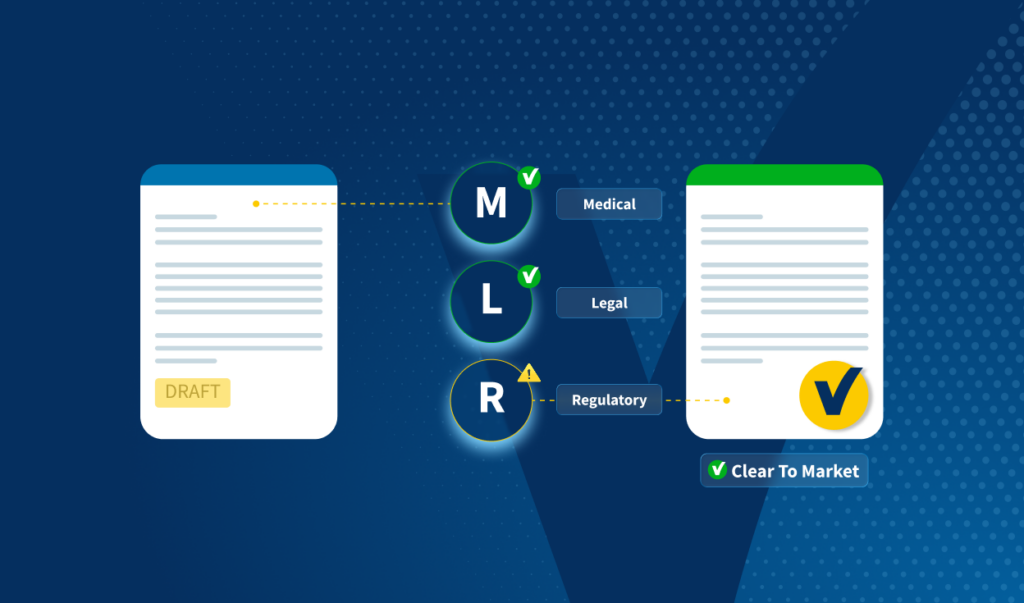
Most organisations, large and small, have some version of a Medical, Legal and Regulatory (MLR) review process for promotional materials. The structure varies: in smaller companies it may sit within regulatory affairs or marketing; in larger ones it typically involves a formal Promotional Review Committee (PRC) or Internal Review Board (IRB). In some cases it’s handled by external agencies with relevant expertise.
Regardless of structure, best practice involves verifying that every promotional piece, at every stage of production, in every format, is consistent with the approved version. That consistency check is where content verification software earns its place.
TVT content verification software compares any two documents for deviations: the MLR-approved master against downstream digital, print, and online versions. It works across any file format combination — Word to PDF, PDF to HTML, approved document to live website URL and flags every difference, however small. No layout change, reformatted paragraph, or transposed figure goes undetected.
When a designer rebuilds your HCP detail aid in InDesign, TVT tells you exactly what changed. When an agency delivers a revised website, TVT compares it against the approved copy word for word. Every deviation is documented, annotatable, and reportable , which matters as much for your audit trail as it does for catching the problem in the first place.
Off-label promotion doesn’t require intent to be costly. It requires only a gap between what your approved labeling says and what your promotional materials communicate. The good news: that gap is detectable, and increasingly, companies aren’t leaving detection to chance.
Want to see how TVT verifies promotional content against approved labeling? Contact us for a demo.
Is off-label prescribing legal?

Yes. Physicians can legally prescribe drugs for off-label uses when they judge it appropriate for a patient. Off-label marketing — promoting those uses in advertising or promotional materials — is what’s prohibited.
What counts as a promotional material under FDA rules?
The FDA’s definition is broad. Promotional labeling and advertising includes journal and broadcast advertisements, internet and digital content, oral statements to physicians, trade fair presentations, and branded materials of all kinds. If it’s devised to promote the product, it falls within scope.
What is the OPDP?
The FDA’s Office of Prescription Drug Promotion (OPDP) oversees prescription drug advertising and promotional labeling. It issues warning letters and untitled letters when it finds communications that are false, misleading, or inconsistent with approved labeling.
Does Health Canada regulate off-label promotion?
Yes. Canada’s Food and Drugs Act and associated regulations prohibit advertising drugs for uses not authorized by Health Canada. The regulatory framework differs in some details from the FDA’s, but the core prohibition is equivalent.
What's a qui tam lawsuit?
A qui tam lawsuit is a legal action brought by a whistleblower (often a current or former employee) under the False Claims Act. The whistleblower may receive a portion of the funds recovered if the lawsuit succeeds — which creates a significant financial incentive for reporting non-compliance internally.