The Pharma promotional review process: how to build a compliant MLR workflow



You’ve done the work. Your drug is approved, your labeling is in order, your promotional strategy is set. Now comes the part that trips up even seasoned regulatory teams: getting every piece of promotional material across every channel, format, and market to match what the FDA, Health Canada, or the EMA, has actually approved.
This is the job of your promotional review process. And in most pharmaceutical companies, it’s also one of the biggest sources of compliance risk.
What is the MLR review process?
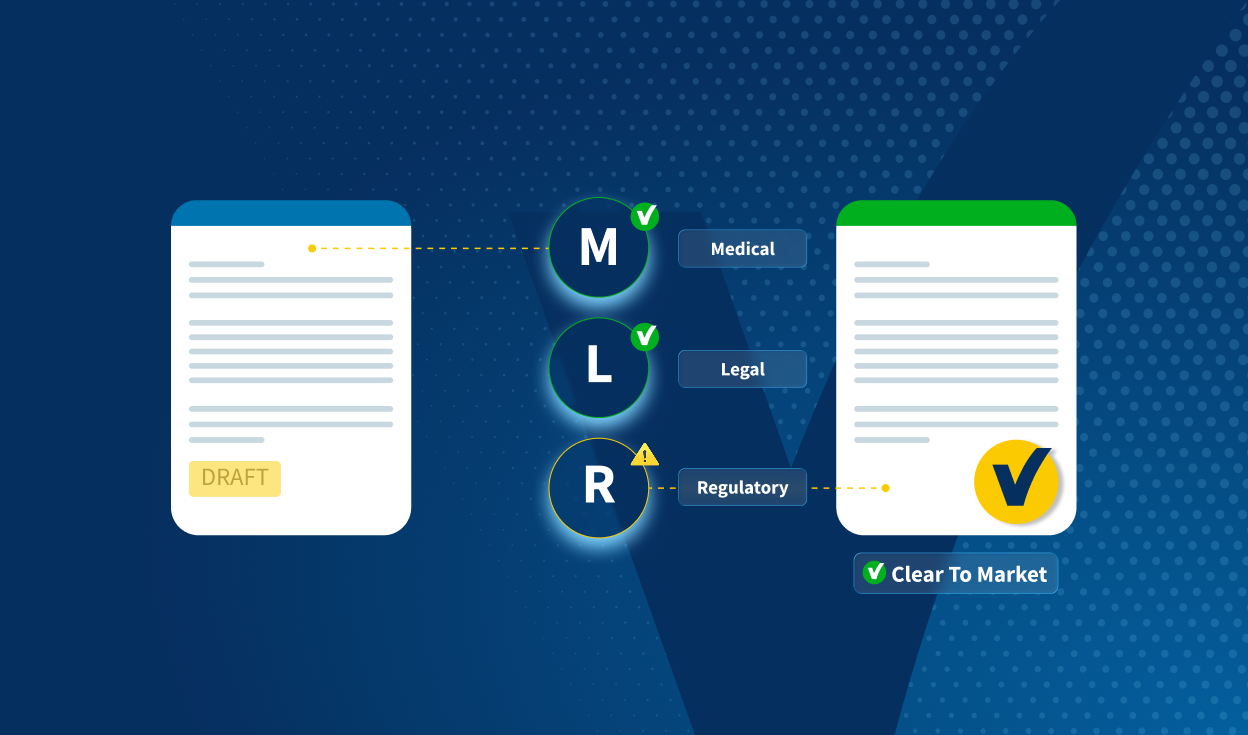
MLR stands for Medical, Legal and Regulatory, the three functions that must sign off on promotional and advertising materials before they go to market. The MLR review (sometimes called the PRC, or Promotional Review Committee, in larger organisations) exists to verify that promotional content is consistent with approved labeling, makes no false or misleading claims, and meets all applicable regulatory requirements.
In the US, the FDA’s Office of Prescription Drug Promotion (OPDP) holds companies accountable for everything in that category — advertisements in print and broadcast media, websites, HCP communications, trade show materials, sales representative scripts, speaker slide decks, and more. In Canada, Health Canada’s Food and Drugs Act imposes equivalent requirements. Across the EU and other regulated markets, country-level bodies apply similar frameworks.
The regulatory exposure is real and significant. Warning letters from OPDP can result in mandatory correction campaigns. Off-label promotion claims under the False Claims Act can result in multi-billion dollar settlements. And qui tam provisions mean that employees have a financial incentive to report non-compliance; making internal gaps an external risk.

Who is responsible for promotional review?
It depends on the organisation’s size and structure. The DIA Ad/Promo conference has consistently highlighted that there’s no single model, what matters is that medical, legal and regulatory expertise are all represented in the process.
In smaller companies, promotional review responsibilities are often bundled within regulatory affairs or marketing departments, or outsourced to specialist agencies with MLR competencies. In larger companies, a formal PRC or IRB provides oversight with defined roles and escalation paths.
What’s consistent across all models is that marketing alone cannot sign off on promotional content. The medical function needs to attest to clinical accuracy. Legal needs to assess liability exposure. Regulatory needs to confirm consistency with the approved label. Miss any one of those, and you have a gap.
That gap matters more now than it did five years ago. The scope of promotional materials has expanded significantly, digital channels, social media, patient advocacy platforms, programmatic advertising and each new format brings new ways for approved content to become non-approved content when it’s adapted, reformatted, or republished.
Where MLR review most often breaks down
Most organisations have a strong process for the initial MLR review of a promotional piece. Where things tend to unravel is downstream.
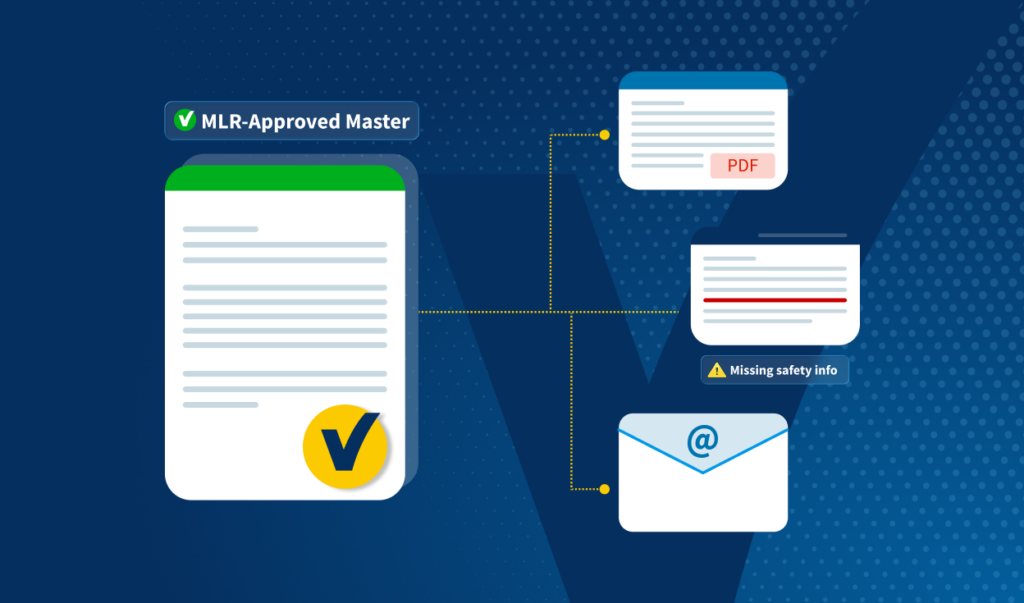
Consider what happens after a piece of copy is approved in MS Word format by the MLR committee. It gets handed to a designer who builds it into a detail aid. That goes to a different agency for digital adaptation. The digital team creates a website landing page, an email, and a set of social assets. Each handoff is a potential point of deviation.
It only takes one contraindication paragraph getting dropped for space, one dosage figure being transposed by a contractor, or one placeholder line not being deleted before launch. None of those require anyone to be negligent. They’re the ordinary consequence of content moving across multiple formats, teams, and tools without systematic verification.
The consequences, however, are anything but ordinary. The cost of cancelling, reworking, and re-launching non-compliant materials is significant. The reputational cost of a public warning letter is harder to quantify but just as real.
The three pillars of a robust MLR workflow
Building a more resilient promotional review process comes down to three things: a reliable document centre, efficient workflows, and the right tools for cross-format verification.
A reliable document centre means your approved labeling and core promotional assets are version-controlled, correctly tagged, and accessible to everyone who needs them — including the teams adapting content downstream. When people can’t easily find the current approved version, they work from memory or from older files. That’s how off-label content enters the supply chain.
Efficient workflows mean review cycles are structured so that deviations are caught early, not just at the final sign-off stage. The later in production a problem is found, the more expensive it is to fix. Build verification into the workflow at each major adaptation point — when a Word document becomes a PDF, when a print piece goes digital, when content is adapted for a new market.
Cross-format verification tools close the gap that manual proofreading cannot. A trained reviewer reading a 24-page detail aid against an approved master is working at the limit of human attention. Studies consistently show that even skilled proofreaders miss a significant proportion of deviations when reviewing long documents. The risk isn’t poor performance — it’s the inherent limit of the task.
Faster onboarding and more time for creative advertising tasks
Manual proofreading doesn’t scale, especially in a fast-moving healthcare advertising agency where new hires need to get up to speed fast and deadlines don’t wait. Tank Worldwide solved both problems at once.

How content verification software supports MLR review
Content verification software compares the approved document against any downstream version and flags every deviation — regardless of layout changes, format differences, or language. It doesn’t tire. It doesn’t miss a transposed digit because it’s on the seventh document of the day.
TVT content verification software is built specifically for the regulated industries where this matters most. A comparison between your MLR-approved Word document and the final PDF, or between approved copy and a live website URL, takes minutes and produces a fully annotated deviation report that becomes part of your audit trail.
That last point, the audit trail, is increasingly important in the context of OPDP enforcement and internal compliance programs. Being able to demonstrate that every piece of promotional material was systematically verified against approved content, with documented sign-off at each stage, is the difference between a defensible process and an exposed one.
AstraZeneca’s experience is instructive here. After deploying TVT across its global regulatory labelling and packaging operations, the team reported up to a 100% increase in QC output — not because reviewers were working harder, but because the mechanical task of word-for-word comparison was handled by the software, freeing reviewers to focus on substantive judgement calls. The audit trail built into TVT’s comparison reports also gave the team documented evidence of compliance at every stage of the process.
Tank Worldwide, a healthcare advertising agency that supports many Canadian pharmaceutical companies, saw a similar pattern. By automating the word-for-word comparison element of promotional review, the QC team could focus on higher-value activities: stylistics, messaging consistency, readability, and accessibility compliance. Notably, TVT’s ability to check reading order is directly relevant to digital accessibility requirements — an area where Canadian and EU regulations have become increasingly stringent.
A practical checklist for promotional review teams
These are the questions your process should be able to answer confidently for every promotional piece:
- Is this version of the content compared against the current approved labeling?
- Has every adaptation of this content — across formats, channels, and markets — been verified against the approved master?
- Is there a documented record of that verification?
- Are all reviewers working from the same current version of the approved document?
- Is the version trail clear enough that you could reconstruct the review history if challenged?
If any of those questions produce hesitation, the gap is worth closing before materials go to market.
What does MLR stand for in pharma?

Medical, Legal and Regulatory — the three functions that must review and approve promotional materials before publication. Some organisations use the term “PRC” (Promotional Review Committee) or “IRB” (Internal Review Board) for the formal body that oversees this process.
What types of materials need MLR review?
Any material that promotes a prescription drug falls within scope: journal and broadcast advertising, websites, email campaigns, detail aids, HCP slide decks, speaker materials, trade show exhibits, sales training documentation, and social media content. The FDA’s definition of “promotional labeling and advertising” is broad.
How does Health Canada approach promotional review?
Health Canada’s regulatory framework for prescription drug advertising is set out in the Food and Drugs Act and associated regulations. The Pharmaceutical Advertising Advisory Board (PAAB) provides pre-clearance review for pharmaceutical advertising directed at healthcare professionals. All promotional content must be consistent with the approved product monograph.
What's the difference between a warning letter and an untitled letter from OPDP?
Both are forms of FDA enforcement action for promotional violations, but a warning letter indicates a more serious violation and typically requires a mandatory response. Untitled letters are less formal but still require corrective action. Both are publicly posted on the FDA website.
Can agencies be held responsible for off-label promotional content?
Pharmaceutical companies bear primary regulatory responsibility for their promotional materials, regardless of whether an agency produced them. However, contracts between pharma companies and agencies typically include compliance representations. The trend in the industry is toward shared responsibility and shared tooling — including having agencies use the same verification software as the pharma client.