Biotech regulatory compliance: how to ensure accuracy, safety, and audit readiness


Table of contents
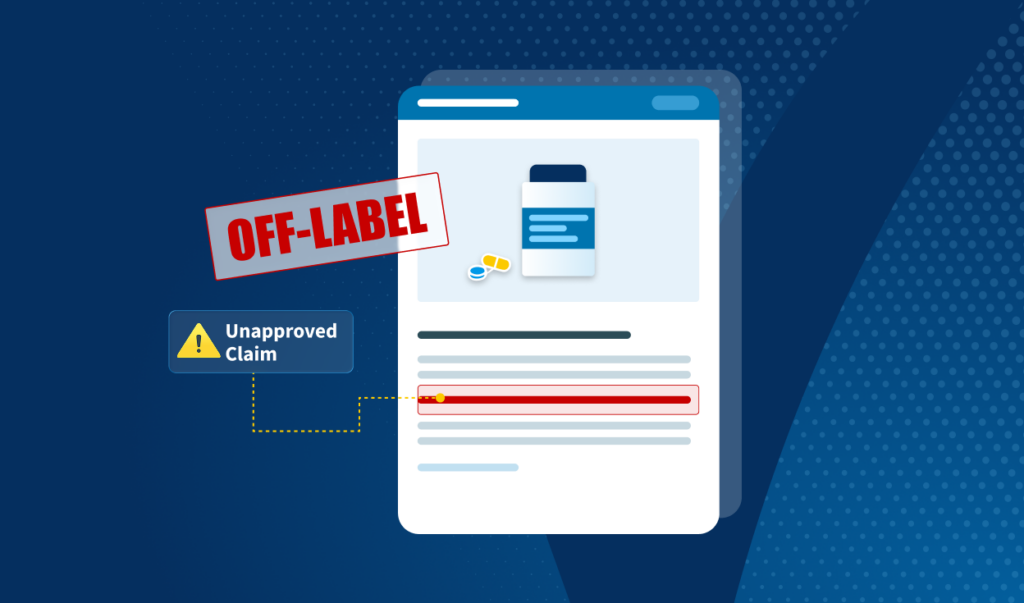

How to ensure accuracy, safety, and audit readiness
The pressure on biotech companies has never been higher. Faster development timelines, global clinical trials, and increasingly complex regulatory landscapes mean that compliance isn’t just a checkbox — it’s the backbone of your entire operation. A single labeling error, a missed version update, or a gap in your audit trail can derail an approval, delay a trial, or put patients at risk.
This guide breaks down what biotech regulatory compliance looks like in 2026, where the most common failures occur, and how high-growth biotech teams are using automation to stay ahead of auditors — and the competition.
What is biotech regulatory compliance?
Biotech regulatory compliance refers to the processes, controls, and documentation practices that ensure a biotech company’s products, trials, and communications meet the standards set by regulatory bodies such as the FDA, EMA, and other national health authorities.
At the heart of this framework are GxP standards — an umbrella term covering Good Manufacturing Practice (GMP), Good Clinical Practice (GCP), Good Laboratory Practice (GLP), and more. These guidelines govern everything from how clinical trials are conducted to how drugs are labeled and packaged.
Where biotech differs from pharma is in pace and scale. Traditional pharmaceutical companies operate with large, established regulatory teams and decades-old processes. Biotech scale-ups, by contrast, are often running lean teams through rapid iteration cycles — protocol amendments, dosage updates, new indication filings — all at once. That agility is a competitive strength, but it dramatically increases the surface area for compliance risk.
Compliance applies across the entire product lifecycle:
- Clinical trials — labels, Instructions for Use (IFUs), patient-facing materials, and informed consent documents
- Manufacturing and packaging — artwork, carton copy, and insert text tied to approved specifications
- Regulatory submissions — dossiers, safety data, module content that must be consistent across all formats and geographies
Biotech Labeling Workflow
Discover how biotech companies manage labeling from development through commercialization. Learn how structured workflows, effective review processes, and automated verification help reduce errors, accelerate approvals, and support global regulatory compliance.
Why compliance is critical in biotech scale-ups
Biotech companies face a compliance challenge that is structurally different from their larger pharma counterparts. Three factors converge to create elevated risk.
High change frequency. A Phase II protocol amendment triggers a cascade of document updates — labels, IFUs, safety inserts, and translated materials. When you’re running multiple trials across multiple geographies simultaneously, tracking those changes manually is not just inefficient; it’s dangerous.
Smaller teams, higher manual risk. Many biotech companies in growth phases don’t yet have the regulatory infrastructure of a large pharma organization. Fewer reviewers, faster timelines, and more documents per person means the margin for human error is thin.
Global trials, multilingual complexity. Submitting to the FDA is one thing. Running a trial across the EU, the US, and Asia simultaneously means your documentation — and your compliance controls — need to function consistently across languages, regulatory frameworks, and cultural contexts.
The downstream consequences of compliance failures are severe:
- Patient safety risks from incorrect dosage information, missing warnings, or translation errors
- Delayed approvals triggered by inconsistencies flagged during regulatory review
- Audit failures that can result in Warning Letters, clinical holds, or product recalls
Common compliance risks in biotech labeling and documentation
The most frequent compliance failures in biotech don’t come from a lack of intent — they come from process gaps. Here’s where things typically break down.
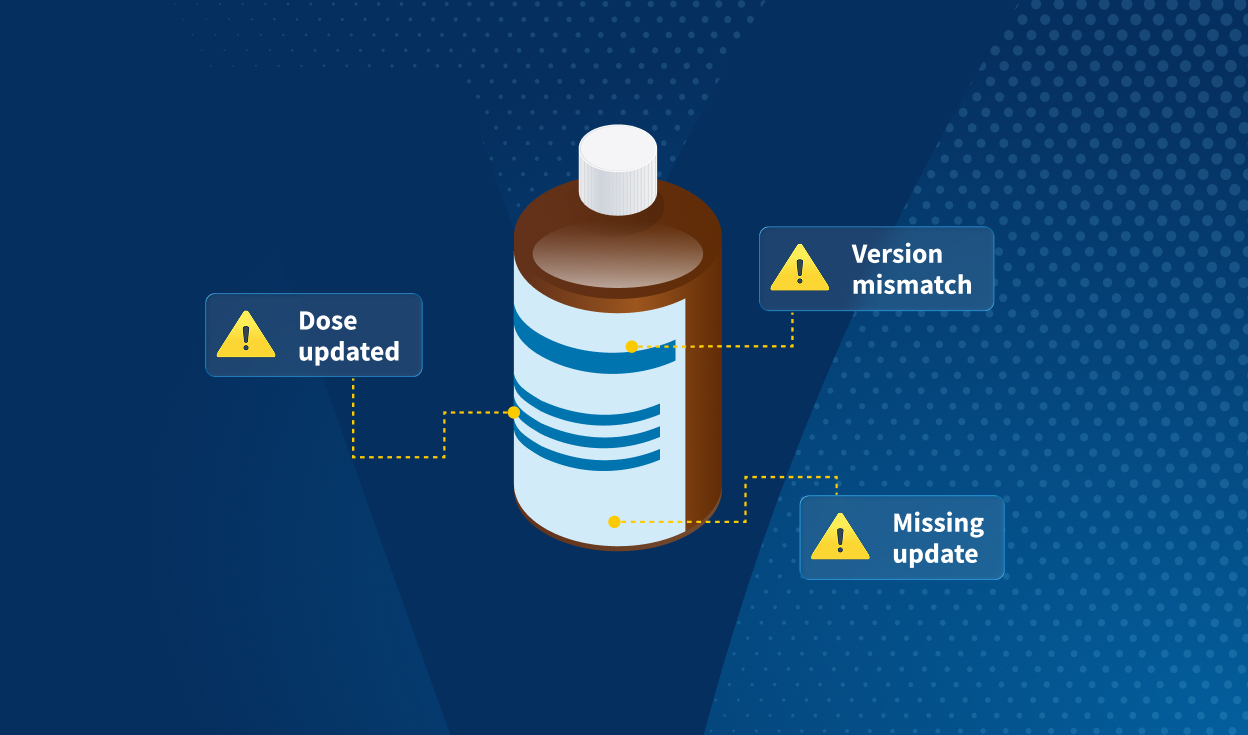
Version inconsistencies across trial documents. When the protocol changes but the label, IFU, or patient information leaflet doesn’t update in sync, you have a version mismatch. In a distributed team working across cloud drives, email threads, and multiple CROs, these disconnects are startlingly common.
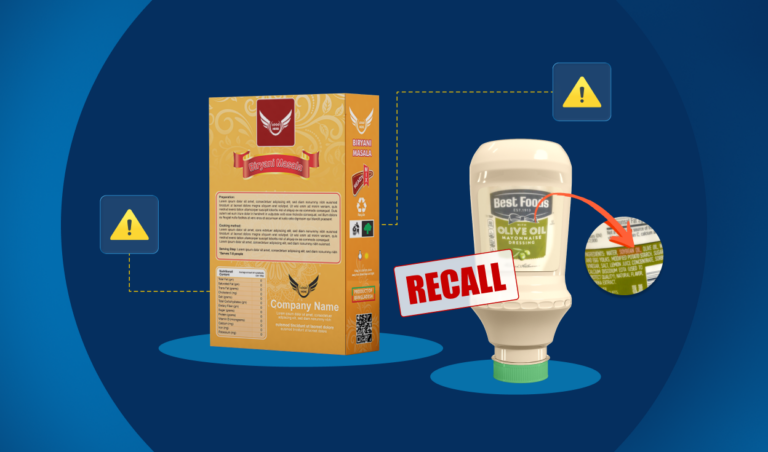
Mismatch between approved data and packaging artwork. The regulatory-approved text and the artwork sent to print should be identical. In practice, late-stage edits, manual copy-paste processes, and format conversions (Word to PDF to XML) create opportunities for errors to slip through.
Translation errors in global trials. Translating clinical and regulatory content isn’t just a language exercise — it requires preserving the regulatory intent of the source document. Errors in translated labels can result in sites using incorrect materials and regulators rejecting submissions.
Missing or incorrect safety information. Safety warnings, contraindications, and adverse event language must be present, accurate, and consistently worded across every document format that reaches a patient or healthcare provider.
Lack of audit trail and traceability. If you can’t show an auditor exactly who changed what, when, and why — across every document in your submission package — you have a compliance gap, regardless of whether the content itself is correct.
Where traditional compliance processes break down
Even well-intentioned compliance programs fail when they rely on manual processes at scale. The structural weaknesses are predictable.
Manual proofreading across multiple formats. Comparing a clinical protocol to a label, and that label to a printed carton, across Word documents, PDFs, and XML files, is not something humans do reliably at speed. The cognitive load is too high, and the risk of confirmation bias is real.
Disconnected systems. Clinical teams work in one system, regulatory teams in another, and artwork teams in a third. Without integration, each handoff is a potential failure point. Content gets copied, reformatted, and occasionally corrupted in transit.
No single source of truth. When approved content lives in multiple places — a regulatory SharePoint, a local drive, an email attachment — it’s nearly impossible to ensure that everyone is working from the current, approved version.
Late-stage error detection. Catching a discrepancy during final artwork review, days before submission, is a crisis. Catching it during controlled content authoring is a minor correction. Traditional processes consistently discover errors too late.
How to ensure biotech compliance: a practical approach
Building a compliance framework that holds up at scale requires more than policy — it requires operational design. Here’s a step-by-step approach that high-performing biotech teams use.
- Establish a single source of approved content. Every piece of regulated text — indication language, dosing information, safety warnings — should live in one controlled location. All downstream documents draw from that source. When the source changes, you know exactly what else needs to update.
- Standardize document structures. Clinical and labeling documents should follow consistent templates and structure conventions. Standardization makes automated comparison possible and reduces the cognitive burden on reviewers.
- Implement controlled review workflows. Every document change should move through a defined review and approval process with assigned roles, deadlines, and sign-offs. Ad hoc reviews are not sufficient for audit purposes.
- Validate multilingual consistency. For global trials, translated documents need to be verified against the approved source — not just for linguistic accuracy, but for regulatory completeness.
- Track every change with audit trails. Every edit, approval, and version change should be timestamped, attributed to a named user, and stored in a system that can produce that history on demand. This is the foundation of 21 CFR Part 11 and Annex 11 compliance.
- Verify final artwork against approved content. Before anything goes to print or submission, run a formal verification that compares the final artwork against the approved content source. This step should be documented and included in your submission package.
The role of automation in biotech compliance
As biotech companies grow, manual compliance processes become a bottleneck. Automation addresses the scale problem without sacrificing rigor — in fact, it improves it.
Many-to-one document comparison allows teams to automatically verify that a label, IFU, and patient leaflet all reflect the same approved clinical content. Instead of three separate manual reviews, a single automated comparison surfaces every discrepancy, instantly.
Automated compliance tools run checks across:
- Text consistency — verifying that key phrases, dosing information, and safety language match across all document variants
- Missing content — flagging required sections that are absent or incomplete
- Regulatory formatting — ensuring that document structure meets applicable regulatory requirements
Critically, automation creates audit-ready documentation as a byproduct of normal operation. Every comparison, every discrepancy flagged, and every approval is logged in a format that satisfies 21 CFR Part 11 and EU Annex 11 requirements — without requiring a separate documentation effort.
Ensure audit-ready compliance across every document and label
Regulatory compliance in biotech isn’t a destination — it’s an ongoing operational capability. The teams that get it right build it into their processes from the start: a single source of truth, controlled workflows, automated verification, and a complete audit trail at every step.
Whether you’re preparing for a regulatory submission, scaling a global trial, or simply trying to reduce the risk of a late-stage error derailing your timeline, the foundation is the same: accurate content, consistent documents, and full traceability.
What regulations apply to biotech labeling?

Biotech labeling is governed by FDA regulations (21 CFR Parts 201, 312, 601), EMA guidelines, ICH standards (including ICH E6 for GCP), and national requirements in each market where a product is developed or sold. Requirements vary by product type, development stage, and geography.
How do biotech companies ensure compliance in clinical trials?
Effective clinical trial compliance combines standardized document templates, controlled authoring and review workflows, version-controlled storage, and regular internal audits. Increasingly, automated document comparison tools are used to verify consistency across trial materials.
What are the biggest compliance risks in biotech?
The most common risks are version control failures, labeling inconsistencies between approved text and printed materials, translation errors in multilingual trials, and insufficient audit trails for document changes.
How can automation support biotech regulatory compliance?
Automation supports compliance by enabling systematic document comparison at scale, flagging discrepancies before they reach reviewers, generating audit-ready records of every change and approval, and reducing the manual workload that contributes to human error under time pressure.
Book your TVT Demo